Jul 2, 2026
Product
What Holds a Multi-Agent System Together
For most of the past two years, the central question in an enterprise architecture review was whether a single agent could handle a given workflow well enough to be trusted with it. In a growing number of cases it now can, and the more interesting difficulty has moved elsewhere. Most serious deployments involve several agents working together, and the trouble tends to arise in the space between them rather than within any single agent. A capable system is a good deal more than a collection of capable agents, and the distance between the two comes down almost entirely to how they coordinate.
This is the aspect of the discipline that has matured most quickly, and also the one that most reference architectures continue to underweight. The agents themselves have become something close to a commodity capability. What distinguishes a multi-agent system that scales from one that never leaves the pilot stage is the layer that governs how work is divided between the agents and how the whole arrangement stays accountable once a dozen of them are acting at the same time.
The coordination patterns have converged
After two years of experimentation, the field has settled on a small set of coordination patterns that recur across almost every production system. The simplest is sequential: work passes through the agents in a chain, each stage refining the output of the last. In a parallel pattern the work fans out and then back in, with several agents addressing a problem at once and a coordinator reconciling their results. A hierarchy introduces a manager agent that decomposes a task and delegates the parts to specialists. Handoff routing has one agent assess a request and pass control to whichever specialist is best suited. And a loop iterates on a result until an evaluation step judges it fit to release.
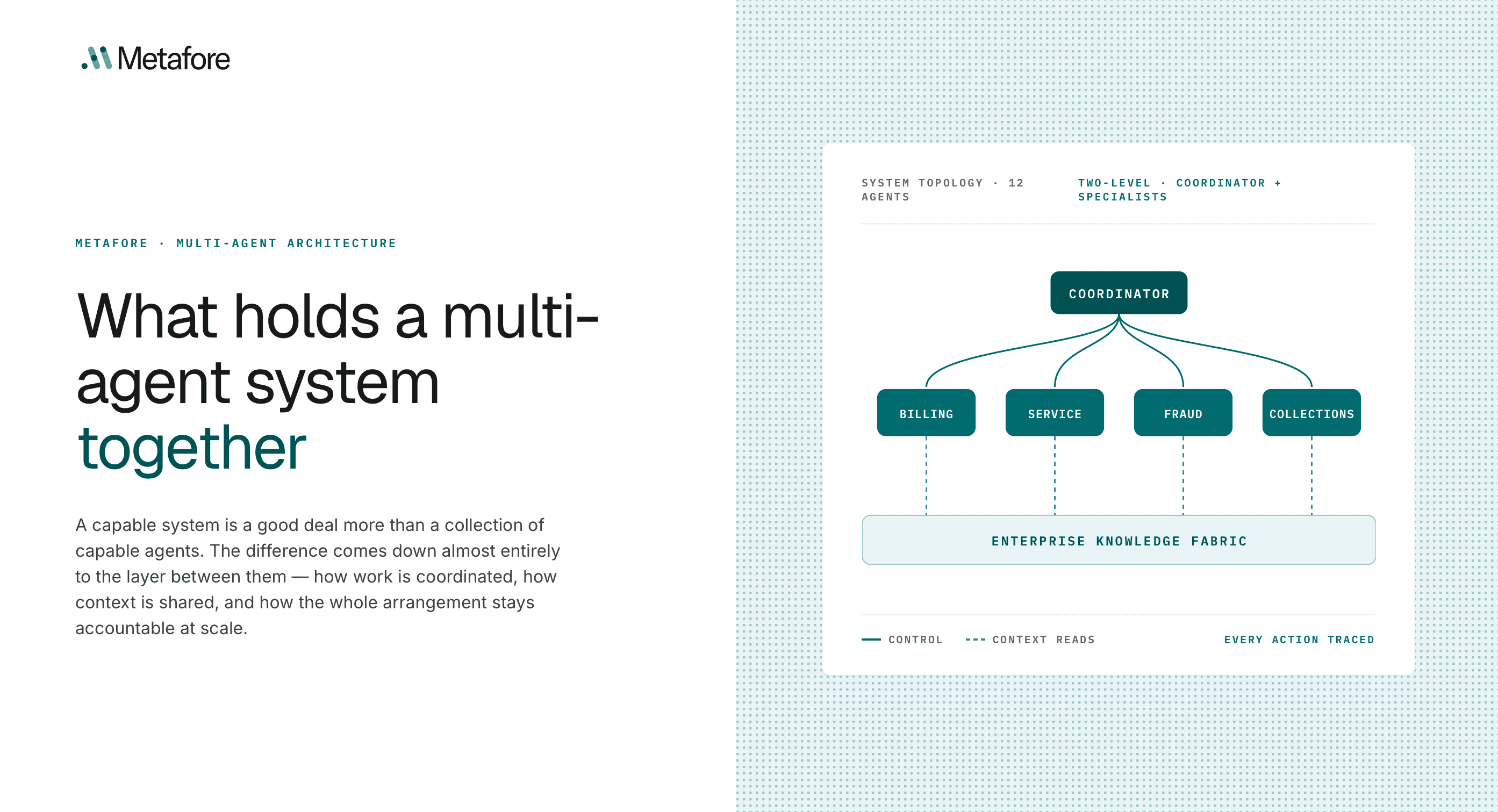
Most systems of any substance combine several of these. What has proved more instructive than the catalogue itself is what practitioners have learned about depth. Two-level arrangements — a router or manager placed above a set of specialists — tend to outperform both flat designs, in which agents negotiate among themselves as peers, and deep hierarchies of three levels or more. The flat design loses coherence because no single agent holds the whole picture. The deep hierarchy loses fidelity because intent degrades slightly at each level it traverses, much as a spoken instruction decays as it is relayed through a chain of people. The two-level shape keeps one accountable coordinator close to the work, and it has become the sensible default.
Where these systems tend to fail
The failure modes of multi-agent systems are, by now, well documented, and they cluster in a telling place. The most common is the coordination loop, in which one agent hands a task to a second, the second finds a reason to pass it to a third, and control eventually returns to the first with no progress made and a little more context lost at each step. Close behind is context overflow, where a planning agent inserts an entire working history into the prompt of the agent it is delegating to, exceeds the available window, and obliges the receiving agent to proceed from a truncated or corrupted picture. Agents drift, departing gradually from the original objective over a long sequence of turns. And agents misuse tools, invoking the wrong function or supplying malformed arguments because they lack the context to do otherwise.
Beneath all four lies the same fact. The majority of multi-agent failures originate in orchestration and context transfer, at the points where one agent hands off to another, rather than in the agents themselves. An agent that performs impeccably in isolation will still produce a broken outcome if the handoff that feeds it arrives incomplete, and the surrounding system has no means of noticing. This is why teams that instrument their agents thoroughly are still caught out. The instrumentation is pointed at the agents, and the failures happen in the handoffs between them, where nothing is watching.
There is a second-order consequence that regulated enterprises tend to discover late. A multi-agent failure that leaves no trace is, in practice, unfixable, because no one can reconstruct which agent acted on which information, and at which moment. When the record of a decision is dispersed across the prompt histories of five agents that have since moved on, the post-incident review becomes an exercise in reconstruction. The cost of that opacity goes well beyond the incident itself. It shows up as an erosion of confidence, and in the workflows that stay beyond the reach of automation because no one can demonstrate what the system would do.
The underlying dependency is shared context
If coordination is where these systems fail, context is the material that coordination moves, and the manner in which an architecture handles context determines almost everything else. In the naive design, context travels inside the messages that agents pass to one another. Each handoff carries a payload of accumulated history, and each recipient reconstitutes its understanding of the situation from whatever that payload happens to contain. The approach holds up in a demonstration involving two agents and a short task. It breaks down as the number of agents and the length of the task increase, because the payload becomes at once too large to fit and too lossy to rely upon.
The alternative is to stop moving context through the handoffs altogether and to give the agents a shared substrate to read from. A knowledge fabric spanning the systems the agents touch allows each of them to draw the context it requires at the moment it acts, rather than depending on a predecessor to have packed the right information into a message. A collections agent and a customer-service agent working the same account consult the same underlying record, rather than two divergent summaries assembled from separate prompt chains. The handoff then reduces to a transfer of control, since the context no longer has to travel with it.
This is the architectural conviction behind cognitive orchestration, and it is the reason Metafore treats the enterprise knowledge fabric as the foundation rather than an accessory. Agents that sense, reason, and act against a common context remain coherent as the system grows, because what keeps them aligned sits outside any individual agent and does not degrade at each transfer. The coordination layer governs control and enforces policy; the knowledge fabric carries the meaning. Separating those two responsibilities is what allows a system to add agents without multiplying the ways in which it can come apart.
Coordination as a first-class layer
The tendency in the early multi-agent work was to treat orchestration as connective tissue — a little routing logic placed between agents that were themselves taken to be the real engineering. That framing produces precisely the fragility described above. Coordination is a layer in its own right. It merits the same design attention as the agents, carrying its own responsibilities and keeping its own record.
Three of those responsibilities matter most. The coordination layer decides how work is allocated, keeping one accountable owner close to each task — the practical lesson behind the two-level hierarchy. It also enforces the boundaries within which every agent operates, evaluating any contemplated action against policy before that action is permitted to proceed, so that a drifting agent is caught at the point of decision rather than in a subsequent audit. The third responsibility is the trace: a continuous record of which agent did what, on what information, and under which constraints, produced as a by-product of the system running and available the moment anyone needs to understand an outcome. An enterprise that builds these three responsibilities into the coordination layer has a system it can extend. One that leaves them implicit has a collection of agents that holds together only until the workflow that breaks it arrives.
Building for this in practice
The practical implications have less to do with tooling than with sequencing. The instinct, when scaling, is to add agents; the more durable course is to invest first in the layer that will hold them together. A team that begins with a clean two-level structure, a shared context substrate from which its agents read, and tracing built in from the very first agent will find that adding the tenth agent is an incremental matter. A team that begins by wiring agents directly to one another, and defers the context and observability work, will find that the tenth agent forces a rebuild — ordinarily under the pressure of an incident or an audit.
Begin with the coordination pattern suited to the work rather than the most elaborate one on offer, resisting the pull towards deep hierarchies that appear sophisticated and behave unpredictably, and give the agents a common source of context before giving them more to do. Instrument the handoffs as closely as the agents, since that is where the evidence of failure will first surface. None of this is exotic engineering. It is a matter of deciding, early, that the system is the architecture, and the agents are components within it.
The system as the unit of design
The enterprises that advance furthest with multi-agent AI over the coming years will be distinguished less by the number of agents they run, or the ingenuity of any individual agent, than by how deliberately they treated coordination and shared context as the architecture from the outset, and built their agents to operate within it. The agents amplify the intelligence of the people who run the business; the coordination layer and the knowledge fabric are what keep that amplification coherent as it scales.
A fleet of agents with nothing beneath them is a liability awaiting the workflow that will expose it. A fleet of agents operating on shared context, beneath a coordination layer that enforces policy and preserves the record, is a system an enterprise can extend into the decisions that matter most. The number of agents is the straightforward part. What determines how far a multi-agent programme can go is the strength of the layer that holds those agents together.

Article by
Metafore Editorial
Subscribe to Metafore blog
Get notified about new product features, customer updates, and more.
related posts


