May 28, 2026
Industry
Why Compliance Can't Be an Afterthought in Agentic AI
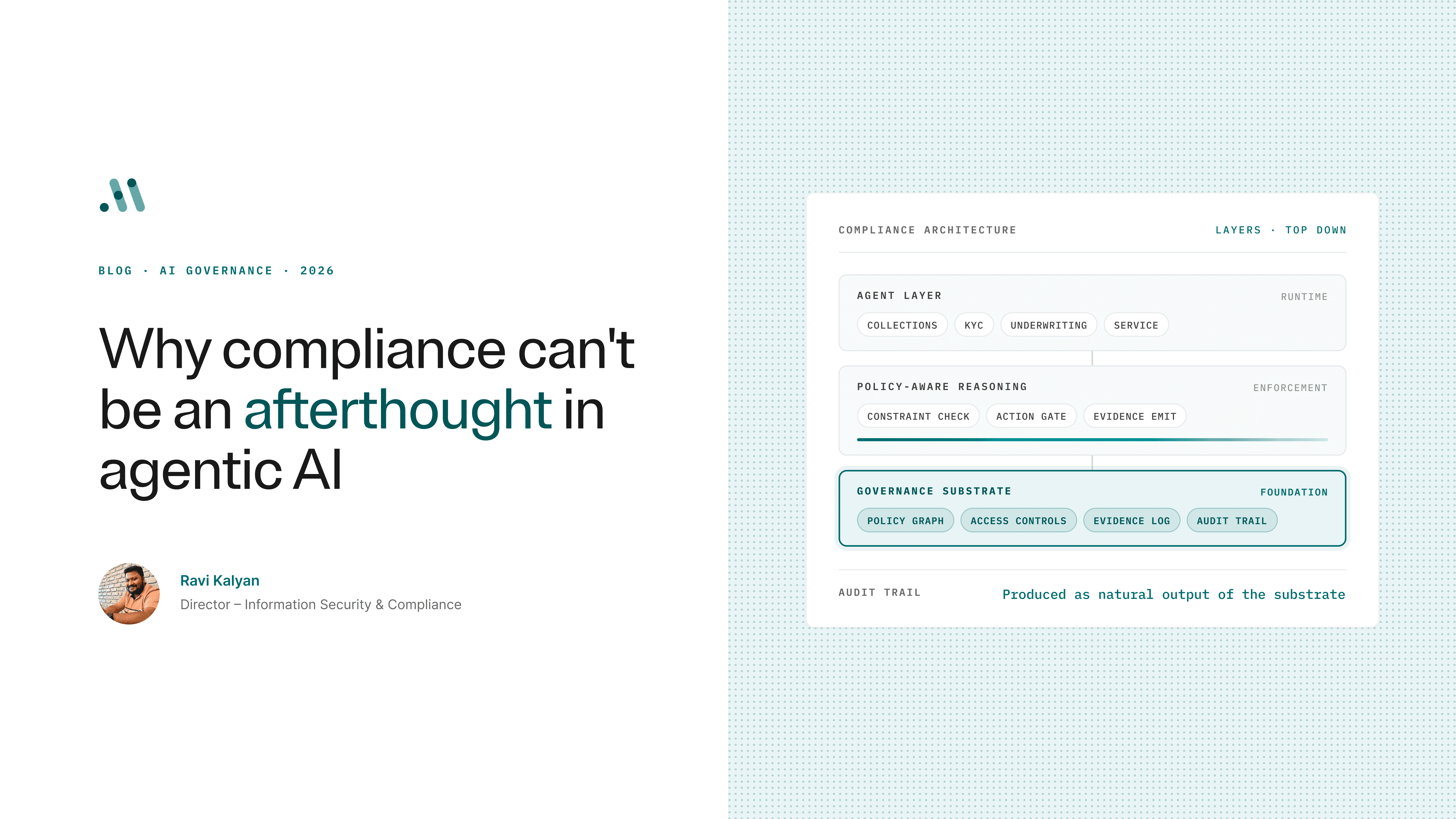
Most enterprises are deploying AI agents faster than they can govern them, and the gap that opens between those two paces is where regulatory exposure accumulates. Closing it requires a decision made at the beginning of the architecture, well before the first agent ships, because retrofitting governance onto a platform that was designed without it produces a permanent friction tax that the enterprise pays for as long as the platform runs.
Walk into any enterprise AI evaluation this quarter and you will see the same governance slide near the back of every vendor deck. It arrives after the demo and the ROI projections, usually as a single page that mentions audit logging, encryption at rest, a compliance dashboard, and some loose language around SOC 2. Then the conversation moves on.
That placement tells you something important about how most vendors think about compliance. They treat it as a layer added once the product was already designed, a feature assembled from logging infrastructure and reporting hooks. Enterprises that accept that sequencing are buying a capable AI platform alongside a permanent compliance program, with the two running on parallel tracks and the second forever chasing the first. The consequence is already showing up in the audit findings of enterprises that moved quickly on AI adoption over the last two years, and that now spend significant engineering time answering questions the platform was never designed to address.
The anatomy of a compliance retrofit
What happens when governance is treated as a layer added after the fact follows a recognizable pattern. The initial deployment performs well, volume gets handled, automation rates climb, and leadership is satisfied with the results. Six to nine months in, the first formal compliance review arrives, and the questions that come back are the ones the platform was never built to answer.
Which agent made this decision, and on what basis? What data did it access at the time, and was that access appropriate given the sensitivity of the record involved? If the agent's behavior has shifted since deployment, what changed, when, and who authorized the change? Can you produce a complete end-to-end audit trail for this interaction, on demand, without engineering involvement?
In a platform built with compliance as an afterthought, the answers to these questions get assembled by hand. Event sequences are reconstructed from logs that were written for debugging rather than audit. Legal teams review outputs with no visibility into the reasoning that produced them, while compliance officers sign off on processes they cannot fully inspect and engineering teams build custom tooling on the side to surface enough of the underlying record to satisfy the next round of auditor requests.
The retrofit cost is real in engineering bandwidth and elapsed time, and in the regulatory exposure that accrues during the months the work is being done. The deeper cost is structural. A platform that was not designed with compliance as a first principle cannot become fully compliant later, because the data model that drives every audit capability, every access control, and every explainability requirement has to be chosen at the start. The foundation of a building has to go in before the building does.
What agentic AI actually changes
Most enterprise compliance programs were designed around human decisions made at human speed. A claims adjuster handles fifty matters in a productive day. A collections manager works a queue that refreshes weekly. Governance built around that cadence operates reactively through sample reviews and periodic audits, and it still catches most of what matters, because the volume is small enough that exception cases tend to surface before they become patterns.
Agentic AI breaks the assumption entirely. An autonomous agent handling collections across a financial services operation is not processing dozens of cases per day. It processes thousands per hour, adapting in real time, making consequential decisions about customer accounts with no human reviewer in the loop for the vast majority of them. The speed difference between how fast the agents act and how fast a reactive compliance program can respond used to be a matter of degree, and it has become a matter of kind.
Regulation is converging on the same point from several directions at once. The EU AI Act, India's evolving DPDP obligations, RBI guidance on AI in financial services, and the emerging US sectoral rules all share a common requirement. The enterprise must demonstrate that its AI systems operate within defined boundaries, that decisions affecting individuals can be explained on demand, and that there is a clear chain of accountability when something goes wrong. The substance of those requirements carries forward from earlier waves of regulation. What has shifted is the scale at which enforcement will be expected, and the operational tempo at which AI runs relative to anything a manual compliance function can match.
Closing that gap requires governance built into the architecture itself. The governance layer has to operate inside the agent's reasoning, applying defined constraints before any action is taken, so that violations are prevented at the source. A monitoring layer that flags problems after they happen will always be a step behind the operational tempo of the platform it was meant to oversee.
The difference that starts in the data model
The distinction between compliance as a feature and compliance as a foundation becomes concrete when you ask a deceptively simple question. Where in the system does a policy live?
In a first-generation platform, policy lives in a document, which informs training, which in turn shapes agent behavior. A separate monitoring system watches the behavior and flags deviations once they have already happened. The distance between the policy intent and the enforcement mechanism is wide, and every audit that has to cross that distance produces findings.
In an architecture designed with governance as substrate, policy lives in the agent's reasoning layer itself. Before the agent acts, it evaluates the contemplated action against the policy constraints that apply to the context, because the architecture does not permit the action to proceed without that evaluation. Every decision carries with it the reasoning that produced it, the policy constraints that were applied at each step, the data inputs that were visible to the agent, and the identity of the workflow that made the call. The audit trail becomes the system's natural output, generated at the moment of decision and stored as a first-class artifact.
The distinction matters enormously in regulated industries. A bank running KYC verification through an AI agent has to demonstrate, for any given customer interaction, precisely what the agent observed, which rules it applied, what determination it reached, and on what grounds. A telecom running autonomous collections needs the same chain of evidence for every account it touches. In each case, explainability functions as the operational record of what happened and why, and the platform has to produce that record automatically, at the pace at which the agents themselves operate.
Three questions every CISO should ask before the next pilot
When an AI platform enters your procurement cycle, three questions will surface the compliance posture more clearly than any slide deck. The answers cost considerably less than a pilot that surfaces the gaps six months in.
Does the platform enforce policy at the point of action, or does it monitor for violations after the fact?
These are different capabilities, and vendors sometimes present them as equivalent. Enforcement at the point of action means the agent cannot proceed with a decision that would violate a defined rule, because the reasoning layer blocks the action before it happens. Monitoring after the fact means the violation occurs, gets flagged downstream, and is addressed retroactively, with whatever remediation the regulator and the affected customer require. Regulated enterprises need enforcement, and most platforms currently offer monitoring with enforcement language attached to the marketing.
Is the audit trail a product of the architecture, or is it assembled from logs?
Ask to see a complete audit trail for a real production interaction, end to end, with no editing and no demo substitutions. If the answer involves log aggregation, custom query construction, or any manual assembly step, the audit capability is fragile and will be expensive to maintain at scale. A purpose-built audit trail is generated as the agent acts, contains the reasoning and the data inputs at each decision point, and is available the moment a regulator asks for it, with no additional engineering work needed to produce it.
Can the platform explain why an agent's behavior has changed over time?
Self-improving agents are a genuine and valuable capability, and improvement without auditability turns into a liability the moment the regulator notices the drift. An agent that behaves differently at month nine than it did at month one needs to explain what changed, when it changed, who or what authorized the change, and on what evidence. If the platform cannot answer that at the level of specific decisions, the enterprise cannot answer it either, and the next regulatory inquiry will arrive well before the engineering team can reconstruct the trail.
Governance as a competitive position
There is a version of this argument that frames built-in compliance as the cost of operating in regulated industries. That framing captures part of the picture and misses the more interesting part. Governance embedded in the platform is a capability the enterprise accumulates over time, with the value growing as the agent footprint grows. Governance retrofitted onto an ungoverned system is a recurring expense that grows the same way, with the same multiplier, and with engineering carrying the load that the platform should have been carrying from the start.
When every agent decision is logged, explainable, and traceable by design, the compliance function itself changes character. The team that used to investigate what agents did after they did it now defines what agents are permitted to do, audits the operating record continuously, and intervenes upstream when boundaries begin to drift. That shift compresses audit cycle times and reduces regulatory exposure, and it makes it possible to extend AI into the sensitive, high-stakes workflows where the largest operational gains actually sit. The enterprises that cannot demonstrate governance in their AI architecture will find those workflows closed to them, because the risk calculus that any reasonable board applies will keep AI out of the decisions that matter most.
The enterprises that move furthest with agentic AI over the next three years will be the ones that built the governance substrate that made those agents trustworthy enough to operate inside the decisions that matter most. That substrate is an architecture decision made before the first agent is deployed, before the first workflow is mapped, before the first integration is written, and before the procurement conversation even begins.
The compliance question deserves to lead the platform evaluation, because the answer to it determines the shape of everything that follows. Start with governance, and the rest of the architecture organizes around something the regulator and the board can already trust.

Article by
Ravi Kalyan
Subscribe to Metafore blog
Get notified about new product features, customer updates, and more.
related posts


