Aug 3, 2026
Industry
Why nobody has solved the banking ontology problem

Every bank now running a serious AI program eventually arrives at the same uncomfortable discovery. An agent asked to refresh a KYC file or flag a covenant breach has to know what those things mean inside that institution, and the meaning lives scattered across dozens of systems that each define it a little differently. A large language model can draft a plausible policy rule in seconds, and the ease of the drafting obscures where the difficulty actually sits. The model has no reliable way of knowing which provision was superseded last quarter, or which of four conflicting customer records is the one a regulator would recognize, because those are questions of lookup and governance that no amount of fluency can answer.
The industry has a name for the missing layer. An ontology is the formal model of what a bank's concepts mean and how they relate, the thing that lets a system know that a beneficial owner is a kind of party, that a covenant attaches to a facility, that a dormant account is still an account. Banking has been trying to standardize this for decades, and it is worth understanding why the effort keeps stalling, because the reasons explain a great deal about why enterprise AI in banking underdelivers.
A standard for every silo
The first thing to understand is that banking does have standards, and some of them are excellent. The trouble is how they are organized. Each one grew up inside a line of business or a market function, was enforced selectively by whichever regulator or market infrastructure needed it, and stops precisely at that boundary.
The ISDA Common Domain Model gives derivatives, securities lending, repo, and bond transactions a shared machine-readable representation, and it says nothing at all about retail products or deposits. ISO 20022 has become the global data dictionary for how money moves, which is why the payments world has spent years migrating to it, yet it describes messages in flight rather than the business relationships behind them. MISMO does careful, detailed work on the loan lifecycle for US residential mortgages and travels no further than that market. Above all of these sit vocabulary layers such as FIBO, BIAN, and FIX, each offering a shared language for some slice of the industry.
Inside a single institution the picture repeats itself. Retail deposits and core banking, credit cards, commercial lending, and wealth management each run on what amounts to the institution's own bible for that business, written over decades of system migrations and acquisitions. There is no global standard that spans them, and there is rarely even an internal one. When an AI initiative needs a unified view of a customer who holds a mortgage, a card, a deposit account, and a brokerage relationship, the team discovers that the bank has never actually written down, in any machine-usable form, what unifies them.
Vocabulary carries you only so far
The second reason the problem stays unsolved is subtler. Most of the standards that do exist stop at vocabulary. FIBO is the clearest example, and also the most useful one, because it gives the industry a dictionary that everyone can agree to use, with careful definitions of thousands of financial concepts. Agreement on vocabulary is genuinely valuable, and any credible banking ontology should be able to demonstrate how it maps to FIBO.
A dictionary, however, does not run transactions. Knowing the agreed definition of a covenant tells a cognitive agent nothing about which covenants attach to which facilities at this bank, what a breach obligates anyone to do, within what window, under which regulator's rules. For an agent to act, the vocabulary has to be connected to relationships, constraints, jurisdictions, and logic that can execute, and that reasoning layer still has to be built on top of every standard the industry has produced. Today each institution builds it alone, usually several times over, once per project, with the results locked inside whichever application paid for the work. Our earlier piece on why AI agents need a knowledge backbone covers what happens downstream when that layer is missing, and banking is where the consequences show up most vividly.
The model you draft today is stale by next quarter
Suppose a bank does the work anyway. It commissions an ontology, maps its core systems into it, and wins sign-off from compliance. The third obstacle now appears, and it is the one that quietly kills most of these efforts: drift.
Regulation refreshes continuously, with some provisions amended and others abandoned, so a model validated against this year's Basel and SEC text is partially wrong within a few quarters. The data layer moves underneath, as core systems are replaced and acquisitions bolt new sources onto old assumptions. Every additional jurisdiction the bank operates in brings definitions that almost match the existing ones, which is worse than definitions that clearly differ, because the near-misses are the ones that slip through review. A drafted ontology, in other words, has to be kept alive, and keeping it alive means re-validating against current regulatory text and re-winning compliance sign-off on every material change. That is a standing discipline with named owners, closer to how a bank runs model risk management than to how it runs a data project. One-time consulting engagements produce an artifact, the artifact decays, and two years later the next team starts again from the survey phase.
Why agentic AI raises the stakes
For most of the past decade, the cost of all this was absorbed by people. A stale data dictionary meant slower reporting, painful reconciliations, manual workarounds, and integration projects that ran long. Analysts and operations staff carried the semantic burden in their heads, translating between systems because the systems could not translate between themselves.
Agents change the economics of the problem in both directions. Drafting is now nearly free, since a model can generate a plausible rule or a plausible mapping on demand, and this floods the zone with unvalidated meaning. Acting is also nearly free, which means an agent operating on last year's definition of an eligible counterparty will make today's mistake at machine speed and at scale. What remains scarce, and becomes decisive, is validated meaning that is governed well enough to stay current. Supervisors and model risk teams are already asking the question that exposes the gap: what did the system know at the moment it acted, and which version of which rule did it apply? A bank that cannot answer with a versioned, auditable chain from decision back to definition will find its AI program confined to the workflows where the answer never gets asked.
What a workable solution actually requires
None of this argues that the problem is impossible, only that the industry has been solving the wrong layer of it. Looking at where every previous effort stalled, a banking ontology that agents can safely act on needs four properties working together.
Governed. Expert validation against current regulatory text, with formal compliance sign-off and re-certification on every material rule change.
Interoperable. A documented crosswalk to FIBO and the other established vocabularies, so a new institution can verify how the model relates to what it already trusts instead of re-litigating every definition.
Jurisdiction-aware. Local regulatory definitions layered over one shared concept model, so the same customer, product, and obligation concepts hold everywhere while each regulator's specifics apply where they should.
Time-aware. Every fact and relationship versioned, so the system can answer what was true when, which is the question every audit and every investigation ultimately turns on.
There is a fifth property that follows from the other four: the model has to be load-bearing. An ontology maintained as documentation will always lose the fight for resources, whereas one that live agents reason over in production is corrected by reality every day, because every decision that flows through it either confirms the model or exposes where it is wrong.
The foundation, then the agents
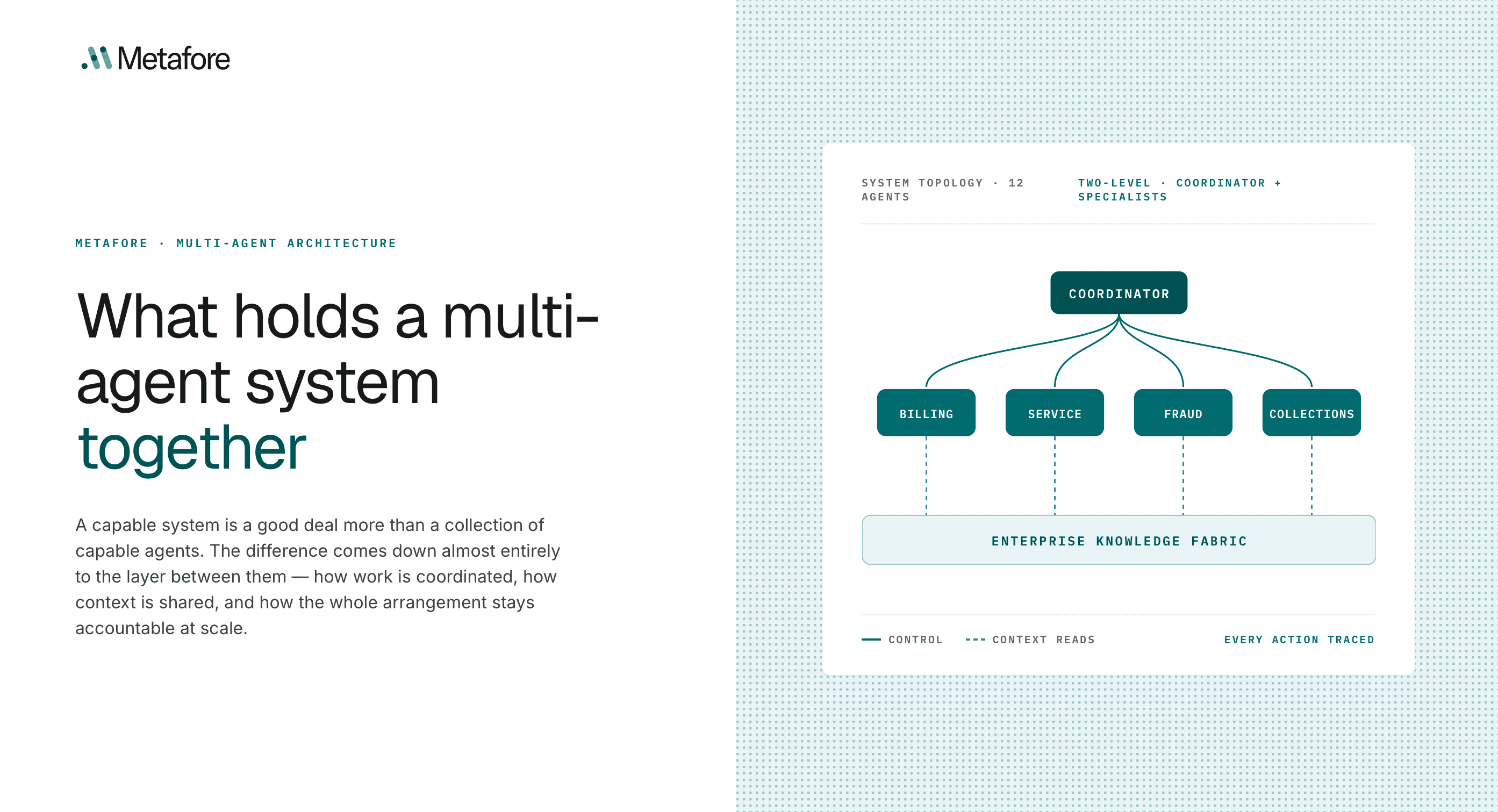
This is the layer Metafore builds first. The platform's enterprise knowledge fabric gives a bank a governed semantic foundation spanning its fragmented systems of record, with cognitive agents that sense, reason, and act on top of it, and every decision traceable back through the concepts and rules it relied on. It is a deliberate inversion of the usual sequence, in which an institution deploys agents against raw systems and discovers the meaning problem one incident at a time. We have written about what that shift makes possible operationally in AI for banking operations; the ontology is the reason any of it holds up under supervisory scrutiny.
The banking ontology problem has stayed unsolved for as long as the industry has approached it as a standards exercise or a documentation exercise, and it starts to yield once an institution treats meaning as living infrastructure, governed with the same seriousness as the ledger itself. The banks that make that shift will find that everything they want from AI gets easier once the foundation can bear the weight.
Ready to see what a governed semantic foundation looks like against your own systems? Talk to our team about where to start.
Article by
Sumit More
Subscribe to Metafore blog
Get notified about new product features, customer updates, and more.
related posts