Feb 20, 2026
Industry
How AI orchestration will reshape the airport experience
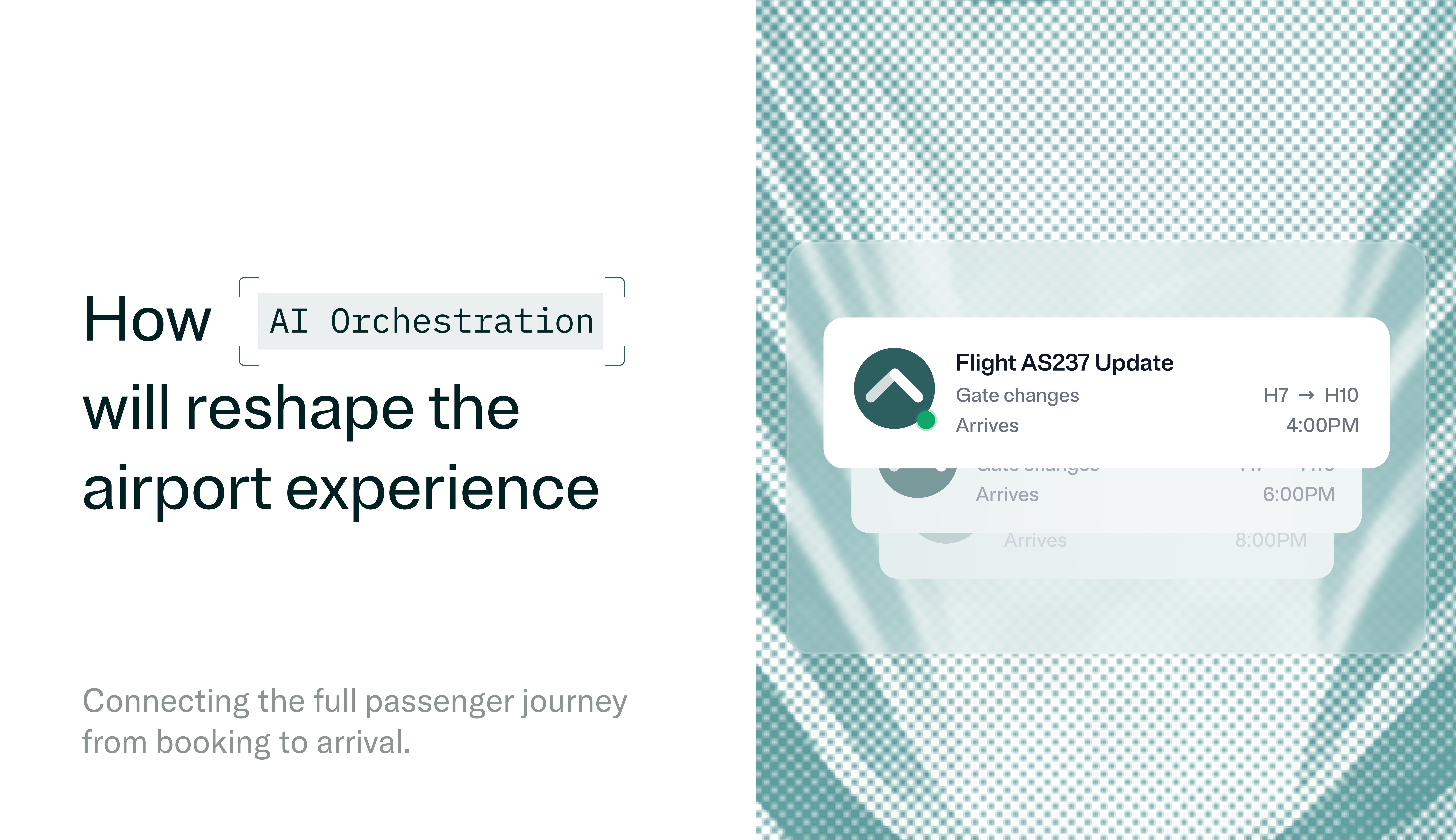
A modern international airport is one of the most complex operational environments on earth. On any given day, a major hub coordinates hundreds of flights, tens of thousands of passengers, dozens of airlines, multiple ground service providers, retail concessions, security operations, customs and border control, and air traffic management — all running on separate systems, managed by separate organizations, optimized for separate goals.
Over the past decade, airports and airlines have invested heavily in AI and sensing technology. Predictive models forecast passenger flow, computer vision monitors security queues, machine learning optimizes gate assignments, IoT sensors track equipment and environmental conditions, and live video analytics measure crowd density in real time. The raw intelligence is there — scattered across 30 or more disconnected systems that rarely share data, never share context, and cannot coordinate a response across organizational boundaries.
The result is an experience that passengers know well: you receive a delay notification from your airline, but no guidance on what to do with the extra time. You land at a connecting hub with 40 minutes to make your gate, but no real-time wayfinding adapted to current terminal conditions. You arrive at the airport two hours early because no system could tell you that security lines were empty and your gate was already boarding.
Each of these moments represents a failure of coordination, and AI orchestration is the architecture that solves it.
The coordination gap in airport operations
The challenge in aviation is structural. Unlike a single enterprise where one IT team can mandate integration across departments, an airport is an ecosystem — a collection of independent organizations operating under shared physical infrastructure, each with their own technology stack, their own data, their own AI investments.
Airlines care about on-time performance and ancillary revenue, while airport authorities focus on throughput and retail spend per passenger. Ground handlers are measured on turnaround time, security agencies on threat detection, and retail concessions on foot traffic conversion. All of these objectives interact with each other constantly, yet the systems behind them almost never do.
When an inbound flight is delayed by 45 minutes, the downstream effects cascade through the entire airport — gate reassignments, ground crew scheduling, connecting passenger logistics, retail forecasting, lounge capacity, even customs staffing at the destination. Today, each stakeholder manages their slice of this cascade independently, with limited visibility into what the others are doing.
AI deployed within any one of these silos can improve that silo's efficiency — better delay predictions for the airline, better queue models for the airport authority, better crew allocation for the ground handler. But none of these individual deployments can solve the coordination problem between them, the compound, multi-stakeholder reality that defines the passenger experience. And that coordination problem is exactly what orchestration addresses.
What AI orchestration makes possible
AI orchestration creates a shared intelligence layer that connects agents, data, and decision-making across organizational boundaries. In an airport context, this means cognitive agents deployed by different stakeholders can reason together — sharing context, coordinating actions, and adapting in real time to conditions that no single system can see on its own.
The shift is architectural. Instead of each organization running its own isolated AI, an orchestration layer allows every participant in the airport ecosystem to contribute to and benefit from connected intelligence. Physical sensing platforms — live video feeds, IoT sensors, crowd analytics, environmental monitors — generate a continuous stream of real-time situational awareness about what is actually happening on the ground. Orchestration turns that awareness into coordinated action. An airline's delay prediction combines with live terminal density data from camera feeds to inform the airport's queue management, which feeds into retail's staffing model, which feeds back into the passenger's real-time journey guidance.
The passenger experience that emerges from this kind of coordination bears little resemblance to what exists today.
Intelligent departure timing
Consider the beginning of the journey. Today, passengers leave for the airport based on rough heuristics — airline check-in windows, rule-of-thumb buffer times, maybe a glance at a traffic app. An orchestrated system draws on real-time traffic conditions, public transit schedules, live video analytics measuring current security queue length, baggage drop wait times derived from sensor data, and gate boarding status to calculate a personalized departure window. The passenger leaves at the right time, arrives without unnecessary buffer, and moves through the airport with minimal waiting — because the system coordinated across transportation, physical airport conditions, and airline data simultaneously.
Adaptive delay management
Flight delays are among the most frustrating moments in air travel, largely because passengers are left to navigate the consequences on their own. An orchestrated airport experience transforms delay time from dead time into managed time. When a delay is detected, cognitive agents immediately assess the passenger's options — lounge access and current capacity, restaurant availability and wait times, rebooking alternatives, terminal amenities — and present a personalized recommendation calibrated to the length of the delay, the passenger's preferences, and real-time conditions across the terminal. This requires orchestration across airline operations, airport concessions, lounge providers, and retail systems — coordination that no single vendor's AI can deliver alone.
Dynamic hub navigation
Connecting through a major hub with a tight window is one of the highest-anxiety moments in air travel. Passengers land with limited time, unfamiliar terminals, and static signage that cannot account for current conditions — construction detours, closed walkways, crowded corridors. An orchestrated navigation system calculates the fastest route to the connecting gate using real-time terminal data — including live crowd density metrics from video analytics, corridor congestion patterns, and operational status feeds from terminal management systems. It adapts the route dynamically as conditions change, factors in the passenger's mobility, and coordinates with the connecting flight's boarding status to provide accurate, up-to-the-minute guidance. If the connection is at risk, the system can proactively notify the gate agent, arrange priority processing, or initiate rebooking — all before the passenger has to ask.
Why airports need orchestration now
The pressure on airports is accelerating from multiple directions. Global passenger volumes are projected to reach 9.4 billion annual journeys by 2040, according to IATA forecasts — nearly double the pre-pandemic peak. Infrastructure expansion cannot keep pace with that growth, which means airports will need to extract dramatically more capacity from existing facilities. That demands coordination at a level that manual processes and siloed AI simply cannot deliver.
At the same time, passenger expectations are being reshaped by experiences outside of aviation. Consumers who use AI-powered services in retail, banking, and hospitality now expect the same level of personalization and responsiveness when they travel. The gap between what AI can deliver in a coordinated environment and what passengers actually experience at most airports is widening — and airports that do not close it will face competitive and commercial consequences.
The technology to close that gap already exists. Cognitive agents can sense, reason, and act across complex environments. Knowledge graphs can unify data from dozens of disconnected sources. Physical AI sensing platforms — computer vision, IoT networks, digital twins — can generate real-time situational awareness across an entire terminal. Edge computing can push intelligence to the point of interaction. What has been missing is the orchestration architecture that connects all of these capabilities into a coherent system — one that takes raw sensing data and operational metrics and turns them into coordinated, cross-stakeholder action in real time.
The airport as a model for enterprise orchestration
Aviation is a particularly vivid example, but the coordination problem it reveals is universal. Every complex enterprise — telecom operators managing network, service, and billing systems; banks coordinating fraud detection, compliance, and customer service; healthcare systems connecting clinical, operational, and financial workflows — faces a version of the same challenge. The AI capabilities already exist inside these organizations, and the value locked between them dwarfs what any single deployment can capture on its own.
The airport of the future will be defined by how well it connects intelligence across every stakeholder, every system, and every moment of the passenger journey. The organizations building that connected intelligence layer today will set the standard for what air travel becomes over the next decade.
At MWC Barcelona 2026, Metafore is demonstrating exactly this vision at the Airport of the Future pavilion (South Village, SV.12) — with live, interactive demos showing how AI orchestration transforms the passenger experience from booking through arrival. Come see it in person.

Article by
Metafore Editorial
Subscribe to Metafore blog
Get notified about new product features, customer updates, and more.
related posts


