May 15, 2026
Industry
Why supply chain AI pilots die before production
Why supply chain AI pilots die before production
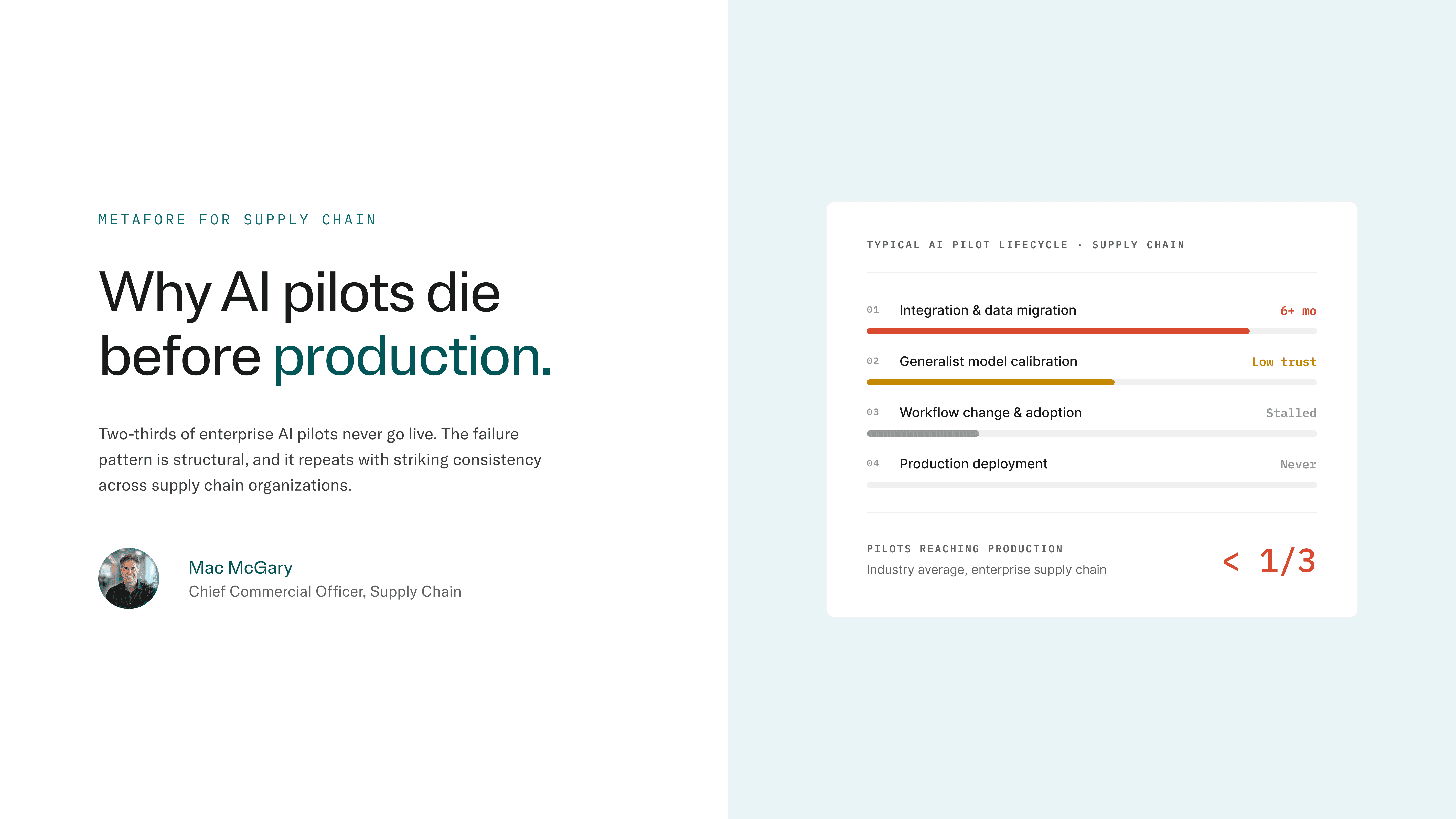
Industry analyst research consistently shows that most enterprise AI pilots — often two-thirds or more — never reach full production. Among the supply chain organizations Metafore works with, the percentage is similar, and the failure pattern repeats with striking consistency. The pilot demos well. The steering committee signs off. Then twelve months later, the integration project has quietly absorbed the budget without producing the outcomes the pilot promised.
If you've led a few of these, you already know where they go wrong. It starts in the same place every AI vendor's first meeting begins: "Before we get started, we'll need to connect to your data." That sentence is the entire problem.
The integration tax
Every enterprise supply chain organization already has more data than it can act on. SAP, Oracle, Kinaxis, Blue Yonder, MercuryGate, project44, FourKites, and a dozen homegrown systems — all of them holding pieces of a picture nobody sees in full. Planners export to spreadsheets. Exceptions route through email. The data exists, but the context needed to act on it doesn't.
So the vendor proposes centralizing everything into a new platform, with its own pipeline and schema. The immediate cost is a multi-quarter engineering project, which everyone expects. The cost nobody plans for shows up later. Every system of record now has a downstream dependency on the new platform. When SAP gets upgraded or the TMS vendor changes an API, the AI platform's ingestion layer breaks, and the transformation promise has become a maintenance liability.
Organizations that respond by hiring more engineers discover the real math. The data layer is a recurring cost that grows with every upstream change, and it absorbs the operational budget the AI was supposed to free up.
When generalist models meet specialist problems
The second failure mode shows up after integration clears — assuming it does. A foundation model trained on general internet data meets a supply chain context and produces outputs that look plausible, right up until someone who actually runs a supply chain reads them.
A planner reviewing a demand forecast knows that a signal in a CRM opportunity stage is weaker than an actual PO commitment, and that both are weaker than a confirmed carrier tender. Those distinctions matter enormously. A generalist LLM weights evidence by word frequency and semantic similarity, which is how its training data was structured. Those signals have no mapping to operational hierarchy, and the model has no way to learn the difference without being built for it.
When a planner reads the output and senses something is off — even if they can't articulate exactly what — trust evaporates. And once trust is gone, the adoption curve dies with it.
Domain expertise has to live at the model layer itself. Supply chain ontologies encode the real semantics: lead times, tender acceptance logic, multi-tier inventory positions, the difference between a forecast and a commitment. Models built on those ontologies produce outputs a planner can defend to a VP of Operations without hedging.
When workflow change comes before proof of value
The third failure pattern is softer, and it's equally fatal.
AI platforms that ask planners to change their workflow before they've seen any value have a predictable outcome: the workflow change never happens. Nobody rebuilds their daily operational rhythm on the promise of a platform that hasn't proven itself yet. You wouldn't, and neither will your team.
The natural order of adoption goes proof first, change second. Most vendor platforms invert that. They ask teams to rebuild their workflow and migrate their data before they've evaluated ROI. In practice, what happens is predictable — planners route around the platform, exceptions continue to flow through email, and the pilot eventually receives a renewal extension because nobody wants to report the failure upward.
The pilot doesn't fail dramatically — it just becomes a line item that gets harder to justify each quarter until someone finally lets it go.
An architecture that inverts the assumptions
Each of these failure modes traces back to a shared set of assumptions — that AI platforms require data migration, generalist models, and workflow conformance as preconditions. Invert those assumptions and the failure modes dissolve.
Start with the data problem. An agent that reasons across existing systems in their native form — SAP, Oracle, Kinaxis, MercuryGate, the visibility platforms — moves the integration tax off the critical path entirely. The data stays where it lives, and the agents do the work of reasoning across it. We call this approach *inference in place*, and it's why pilots built on it typically reach production in eight to 12 weeks instead of stalling at month six of an integration project.
The credibility problem needs a different answer. Metafore's models are trained on supply chain ontologies directly — lead times, tender acceptance logic, multi-tier inventory positions, the semantic weight of a demand signal versus a commitment. These live inside the reasoning layer, so outputs arrive with operational hierarchy intact. Planners trust them because they reflect how the supply chain actually works.
Adoption is the quieter problem, but it's the one that determines whether any of this lasts. Agents that surface exception context inside the screens planners already use — the SAP console, the TMS dashboard, the ops workbench — prove their value before asking anyone to change a workflow. Adoption becomes opt-in, bought one workflow at a time as the hours saved accumulate and the team starts pulling the platform into new processes on their own.
What to look for in your next pilot
The pattern across failed pilots points at architecture. The AI techniques inside most platforms are mature enough to produce useful outputs. What sinks most pilots are the integration and workflow assumptions wrapped around those techniques — the scaffolding the vendor needs to operate, which rarely matches what the supply chain needs to improve.
A platform that requires the enterprise to reorganize around the AI loses. One that reorganizes itself around the enterprise reaches production adoption inside a single quarter.
For supply chain leaders evaluating what to pilot next, the first filter is simple: does the platform require your data to move, or does it reason where your data lives? The answer to that question determines which side of the pilot-failure statistic your next initiative lands on.
Metafore's Solution for Supply Chain is built to reach production inside a single quarter, without a multi-quarter integration project. See how inference in place works →

Article by
Mac McGary
Subscribe to Metafore blog
Get notified about new product features, customer updates, and more.
related posts


