Mar 23, 2026
Industry
Why Your AI Agents Need a Knowledge Backbone
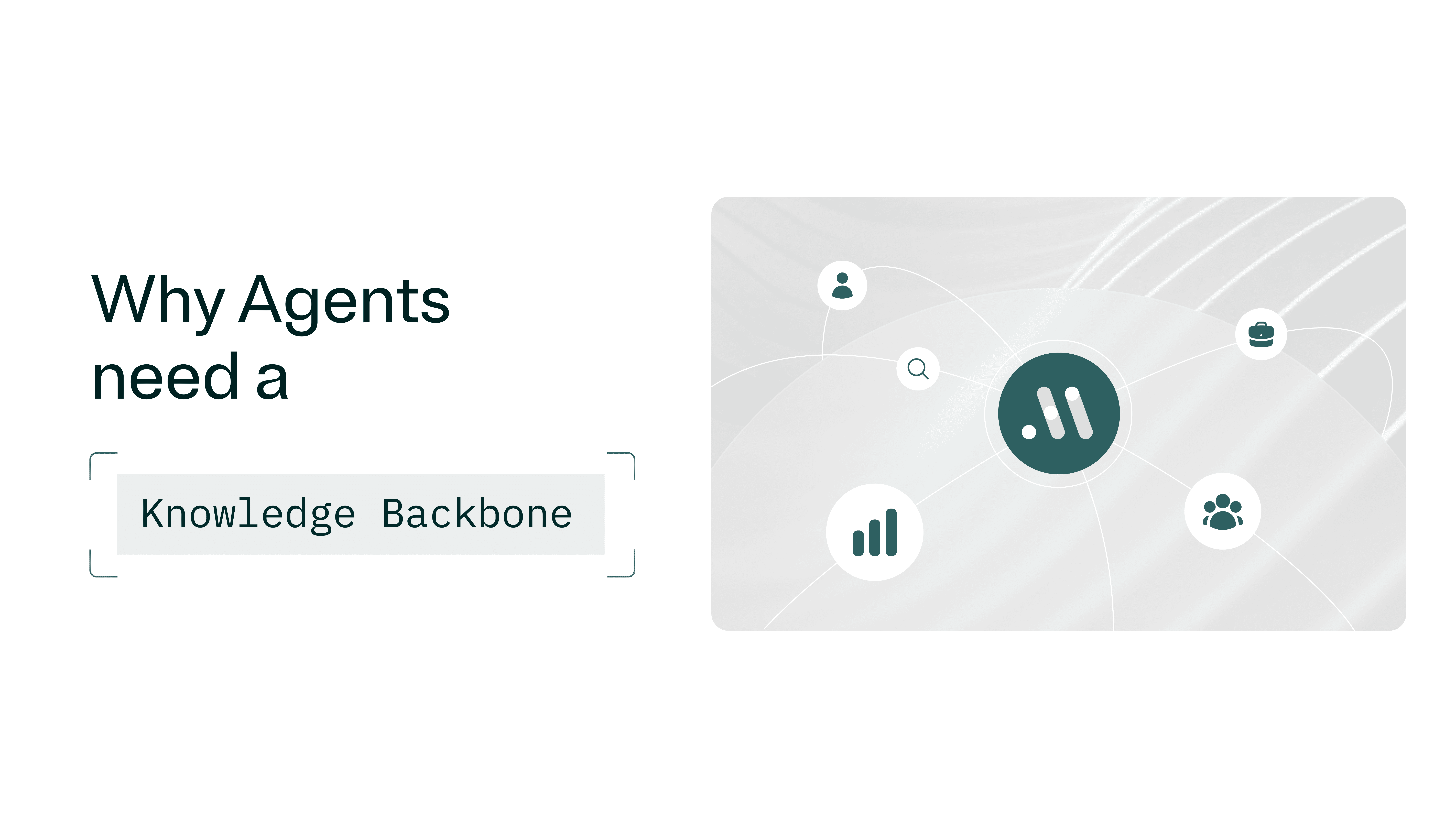
Enterprise AI has an under appreciated dependency problem. Organizations are deploying cognitive agents at an accelerating pace, across customer service, fraud detection, compliance, network operations, and supply chain. Most of those agents are performing well within their assigned scope. The trouble surfaces when you ask what happens between them.
A customer service agent resolves a billing inquiry but cannot access the product usage data that would reveal the customer is about to churn. A fraud detection agent flags a suspicious transaction but lacks the context of a support call the customer made 20 minutes earlier explaining the unusual purchase. A compliance agent audits loan decisions against regulatory criteria but has no visibility into the customer's full relationship history across business lines.
Each agent is capable, but the knowledge connecting them is absent, and that absence defines the ceiling of what enterprise AI can achieve.
What a knowledge backbone actually is
The term "knowledge graph" gets used loosely in enterprise technology conversations, often interchangeably with "data lake" or "data warehouse." They are different things.
A data lake stores raw information. A data warehouse structures it for reporting and analytics. A knowledge graph (what we call the enterprise knowledge backbone) does something more fundamental: it maps the relationships between entities across your organization and makes those relationships available to cognitive agents in real time.
Customer records, billing histories, product configurations, regulatory obligations, partner agreements, support interactions, network telemetry: in most enterprises, this information lives in dozens of separate systems. A knowledge graph connects it into a unified structure where an agent can traverse relationships across those boundaries. The customer is connected to their billing record, which is connected to the product they use, which is connected to the network infrastructure serving it, which is connected to the current operational status of that infrastructure.
When agents can traverse these connections, they reason with enterprise-wide context instead of departmental fragments.
The cost of agents without connected knowledge
The most common symptom is what looks like an AI performance problem but is actually a data architecture problem.
An enterprise deploys a customer service agent that handles 70 percent of inquiries without human intervention. Impressive, until you examine the 30 percent that escalate. A significant share of those escalations happen because the agent lacked context it could not access: a recent outage affecting the customer's region, a pending order in a separate system, a policy change that applies to the customer's specific account tier. The agent was not incapable of reasoning about these factors. It simply could not see them.
Multiply this pattern across every agent deployment in the organization and the cost becomes structural. Each agent hits an intelligence ceiling imposed by its data boundary, and the enterprise compensates with human escalation, manual data lookup, and duplicate agent deployments that overlap in scope but never share what they learn.
The instinct is to solve this agent by agent, giving each one access to additional data sources through point integrations. This approach does not scale. Every new integration is a custom engineering project, and the resulting web of connections becomes increasingly fragile and expensive to maintain.
How a knowledge graph changes agent behavior
The shift from isolated data access to a shared knowledge backbone changes agent behavior at every level of enterprise operations.
Contextual reasoning across boundaries
When cognitive agents share a common knowledge foundation, they stop operating as departmental specialists and start reasoning as enterprise participants. A service agent handling a complaint about slow data speeds can immediately see the network degradation event affecting the customer's cell tower, the engineering ticket already in progress to resolve it, and the customer's contract renewal date, all within the same reasoning chain. The agent responds with full awareness of the situation instead of the narrow view its department provides.
Cumulative intelligence
Every interaction an agent has with the knowledge graph enriches it. A fraud detection agent that identifies a new behavioral pattern contributes that pattern to the shared knowledge backbone, where it becomes available to service agents, compliance agents, and risk models across the organization. Intelligence builds on itself rather than staying locked inside individual agent deployments.
Faster deployment of new agents
When the knowledge foundation already exists, deploying a new cognitive agent becomes a configuration exercise rather than an integration project. The new agent connects to the existing graph, inherits the relationships and context already mapped, and starts reasoning with enterprise-wide awareness from day one. Organizations with a mature knowledge backbone report dramatically shorter time-to-value for each additional agent deployment, because the hardest part of the work (connecting the data) is already done.
Building an enterprise knowledge backbone
Establishing a knowledge graph is not an overnight project, but it follows a pragmatic progression that delivers value at each stage.
Start with the entities that matter most
You do not need to map every data relationship in the enterprise before your knowledge graph becomes useful. Begin with the entities at the center of your highest-value interactions, typically customers, products, and accounts. Connect these to the systems that agents interact with most frequently: CRM, billing, support ticketing, and core operational platforms. This initial graph will immediately expand the reasoning context available to your deployed agents.
Extend through agent usage
As agents interact with the knowledge graph, their activity reveals which relationships matter most and which connections are missing. Use this signal to guide expansion. If your service agents consistently escalate inquiries that require product configuration data from a system not yet connected, that system becomes the next integration priority. The knowledge graph grows in direct response to the intelligence demands of your cognitive agents.
Govern at the graph level
A knowledge graph is also a governance structure. Because every agent reasons against the same foundation, you can enforce access controls, compliance policies, audit trails, and data quality standards at the graph level rather than agent by agent. In regulated industries like banking, telecom, and wealth management, this centralized governance is not optional. It is the only sustainable way to maintain compliance as the number of autonomous agents grows.
The foundation that makes orchestration work
If you have been following this series, you will recognize a recurring theme: enterprise AI works when it works together. Orchestration provides the coordination layer. Governance provides the compliance framework. The knowledge graph provides the shared intelligence that makes both possible.
Without a knowledge backbone, orchestration is just routing: agents passing tasks to each other without shared understanding. With one, orchestration becomes genuine cognitive collaboration, where every agent contributes to and benefits from a living, growing map of your enterprise's operational reality.
For organizations investing in AI, the strategic question is straightforward: are you building the knowledge foundation that your agents need to deliver their full potential, or are you deploying capable agents into an environment that limits them to a fraction of what they could achieve?
Learn how Metafore builds the knowledge backbone for enterprise AI →

Article by
Metafore Editorial
Subscribe to Metafore blog
Get notified about new product features, customer updates, and more.
related posts


