May 21, 2026
Industry
Orchestration Without Context Is Theater
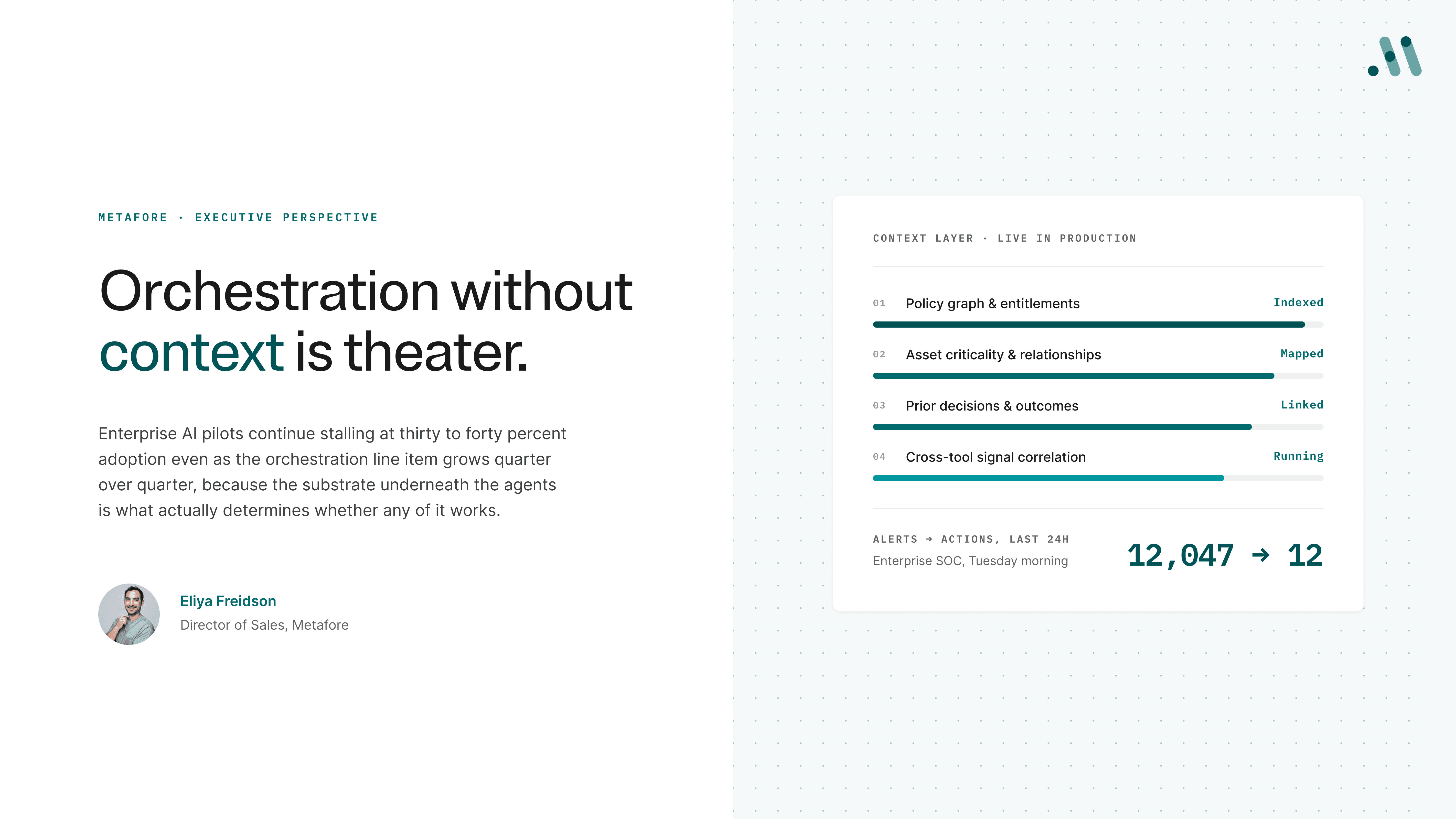
Why enterprise AI pilots stall at thirty percent adoption, and what every CIO should be asking the next vendor on their calendar.
Walk into any enterprise AI pitch this quarter and you will find the same artifact at the center of every deck, which is an orchestration diagram. The shapes vary from vendor to vendor, with workflow engines and multi-agent frameworks and routing layers and agent-of-agents architectures backed by eight-figure roadmaps, but the underlying promise is identical, which is that stitching the agents together is what makes the magic happen.
Your incumbent vendor has one of those diagrams too, and it is worth pausing in the next meeting to ask them what is actually inside the boxes.
Meanwhile your AI pilots continue stalling at thirty to forty percent adoption even as the "AI transformation" line item grows quarter over quarter, which suggests that the vendors are selling you the wrong layer of the stack.
The hidden tax nobody is pricing
Spend an afternoon timing the first sixty seconds of every call on an enterprise support floor, and a pattern emerges almost immediately. The agent authenticates the caller, pulls up the account, identifies the product, opens the prior ticket, checks entitlement, switches tabs, and finally asks the caller to repeat what they already typed into the chatbot, by which point sixty percent of the call has elapsed before anyone has touched the actual problem.
That time is being spent re-assembling context the enterprise already holds. The information lives in the CRM, in billing, in the product console, and in the recording from last week's call, which means that every interaction begins by rebuilding what the systems already know but cannot deliver to the operator in motion.
On a twelve-hundred-person support floor, sixty percent of every interaction across every shift and every quarter is being spent reconstructing what your own systems already know. The arithmetic works out to roughly seven hundred and twenty person-equivalents of daily work that no orchestration layer can recover for you.
The break point in all of this sits well below the orchestration layer, in the substrate that feeds it.
Why orchestration alone fails
An orchestrated agent that does not have access to the customer's history is little more than a faster path to the wrong move, and a multi-agent system that asks the buyer to confirm their company name at every handoff is a science project dressed as a product. Most enterprise AI today sits considerably closer to the second of those descriptions than to the first.
The dividing line between two generations of enterprise AI runs through this point. The first generation bolts AI on top of an existing system of record, which is why the CRM ends up with an "Einstein," the service desk ends up with a "Breeze," and every legacy product picks up an AI feature without gaining AI architecture. The workflows and the field structures stay exactly as they were, and the AI ends up annotating the human's work from the sidelines rather than carrying any of it.
The second generation of enterprise AI is AI-native, designed from the substrate upward around the assumption that cognitive agents will be the primary operators of the enterprise's systems and that humans will be there to review and intervene. In that world, context is the architecture itself, and everything else in the platform follows from that single design choice.
Model selection is largely irrelevant to this conversation, because every vendor in the market is licensing the same frontier models, and what actually separates the two generations is whether the system understands the enterprise it is operating inside.
What rich context actually looks like
Consider a security operations center on a normal Tuesday morning, with twelve thousand alerts that have fired overnight across six different tools. The traditional response, which is to triage everything that can be triaged and to escalate everything that cannot, eventually burns the analyst out by Thursday.
A response built on rich context produces a different picture entirely. The twelve thousand alerts collapse into twelve prioritized actions, each carrying the evidence path that produced it, the recommended next step, a confidence level, and a single approval button. The analyst remains in the loop, but the work itself changes from sifting noise to authorizing intervention.
What produced that collapse was a knowledge graph correlating signals across previously siloed tools, backed by an enterprise knowledge fabric holding policies, prior decisions, asset criticality, and the relationships among them. Once that substrate exists, the orchestration on top of it becomes almost trivial, whereas routing logic running on top of nothing cannot produce the same collapse no matter how cleverly it is wired together.
The same principle applies in customer engagement, where in a properly architected system the conversation itself becomes the activity log. Calls, emails, message threads, and meeting transcripts flow directly into the context fabric, without anyone updating a field or running Friday afternoon CRM hygiene, and the system remembers because the substrate remembers and the agent acts on what is already there.
Context, treated this way, functions as the operational nervous system of the enterprise.
Three questions every CIO should ask the vendor
When the next AI platform pitch lands on your calendar, there are three questions worth asking before any pilot is scoped, and the answers will cost considerably less than the pilot itself.
01 — Where does context live, and how does it persist across sessions?
If the honest answer is "in the prompt," the vendor is selling a chatbot under a more expensive name, whereas the architecture you actually want is one that puts context in a persistent graph or fabric that survives between conversations and accrues over time.
02 — Does the system actually learn from outcomes?
A successful intervention should sharpen the next decision, and a failed one should enter institutional memory rather than disappear when the session ends. A platform that lacks this learning behavior will hit a ceiling within months, because institutional knowledge keeps evaporating with every interaction, and the investment ends up buying a chatbot that is no smarter at quarter eight than it was at quarter one.
03 — Is context the architecture, or is it bolted on?
Strip the demo away and read the data model itself, and the answer becomes immediately visible. If context appears as one feature among many in that data model, the architecture is first-generation tooling dressed in this year's vocabulary, whereas a substrate-first system is recognizable because the data model puts context at the center and treats every feature as an expression of it.
Three questions and twenty minutes of honest conversation will tell you considerably more than six months of pilot, and at a small fraction of the cost.
The moat is underneath
Orchestration matters, but on its own it cannot carry an enterprise transformation of any meaningful scale.
Every competitor in the market licenses the same frontier models that you do, which means the agent layer is no longer where competitive advantage is built. What actually determines whether your AI investments accumulate into a durable advantage or evaporate quarter by quarter is the substrate underneath, meaning the context fabric, the knowledge graph, and the persistent memory on which every agent in the system depends.
Own the substrate and you also own the way your enterprise remembers itself, which is the point at which the orchestration becomes intelligent by default. The substrate is the product, the agent on top of it is an interface to that product, and the rest of the orchestration story, in the absence of that foundation underneath it, amounts to theater.

Article by
Eliya Freidson
Subscribe to Metafore blog
Get notified about new product features, customer updates, and more.
related posts


