May 1, 2026
Industry
The Real Cost of Disruption Lives Between Systems
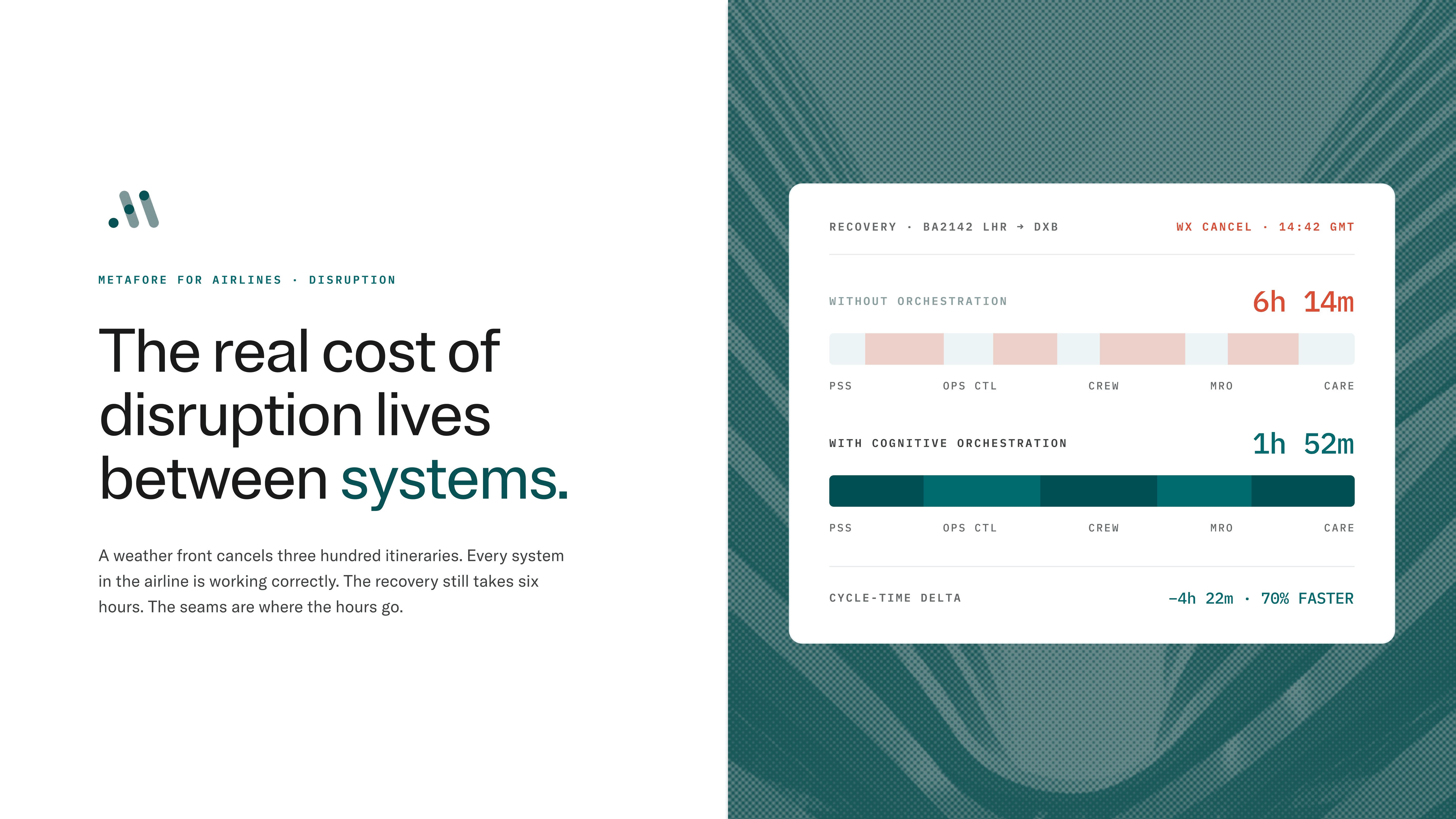
A weather front moves across the Atlantic on a Thursday afternoon, and three hundred passengers lose their itineraries by dinner. The PSS knows the cancellation. The DCS knows the seat manifests. Ops control knows which crews are within duty limits and which aircraft are still available downline. Revenue management knows the highest-value bookings on the affected flights. Customer care knows the elite-tier passengers who are already calling. Every one of those systems is working correctly. The recovery still takes six hours.
For an airline CIO or COO, this scene is familiar enough to be invisible — the operational equivalent of background noise. Most of the cost of disruption is buried in the handoffs between systems that each, on their own, perform exactly as designed. The seams are where the hours go.
A decade of vertical investment has produced excellent silos
The last ten years of airline IT spending have produced individually impressive systems across passenger services, departure control, ops control, MRO, and revenue management. Each platform has grown more capable than its predecessor, and each investment was rational when measured against its own scorecard.
The trouble is that disruption recovery has never been a single-system event. A cancelled flight cascades into rebooking decisions that touch fare rules, hotel inventory, crew duty limits, downline aircraft assignments, gate windows, baggage routing, partner billing, loyalty status protection, and an inbound queue of customers who already know something is wrong. The work of stitching those systems together has historically lived inside human operators — a duty controller on the phone with a revenue analyst while a customer service supervisor manually reviews exception lists. Those operators are excellent at what they do. There simply aren't enough of them, and the playbook gets longer every year.
Point AI hasn't solved a coordination problem
The first wave of AI adoption in airlines has reinforced the silo pattern rather than solving it. A chatbot bolted onto the customer-service stack can answer fare questions faster, but it cannot see the ops-control picture that would let it tell a passenger their connection is already gone. A predictive-maintenance model can flag an AOG risk on a specific tail number without understanding the revenue exposure on tomorrow's schedule. A revenue model can forecast load factors with no visibility into the crew constraints that will reshape capacity in the next twelve hours.
Each of these tools improves a local metric. None of them shortens the recovery cycle, because the recovery cycle has never been a local problem. Coordination is the work, and coordination is the layer that has been missing.
What a reasoning layer actually does
Cognitive orchestration is the discipline of putting that missing layer in place — a system that reads from PSS, DCS, ops control, MRO, revenue management, and customer-facing channels at the same time, holds the full operational picture in working memory, and reasons across them to propose coordinated moves. The systems of record stay where they are, while the agents work alongside the operators who already run the airline.
In a disruption scenario, that means rebooking decisions get made with awareness of fare rules, hotel availability, crew duty limits, and elite-tier policy at once. Hotel and meal vouchers are issued before the queue forms at the gate. Compensation offers go out proactively, calibrated to carrier policy and to the passenger's history. Gate and aircraft reassignments propagate through ops control with the downline impact already calculated. The customer service organization sees the same picture the duty controller sees, in the same moment.
This is the difference between an airline that recovers in two hours and an airline that recovers in six.
What changes for the operator
The shift is most visible at the workspace level. A revenue analyst who used to reconcile interline settlement exceptions in a spreadsheet now works alongside an agent that has already cross-referenced the PSS, the partner billing feed, and the codeshare agreement, surfacing only the cases that genuinely need a human judgment. An ops controller who used to manage disruption recovery across half a dozen consoles reviews proposed moves with full context already attached. A customer service supervisor sees an elite-tier passenger's recovery options resolved in seconds where the same path used to take minutes. The headcount math shifts, but the more important shift is in cycle time — and in disruption recovery, cycle time converts directly into compensation expense, downline propagation, and reputational cost.
For the CIO, the integration story is the part worth understanding. Cognitive orchestration runs against the existing stack. Connectors for SITA, Amadeus, Sabre, Navitaire, and the major DCS and MRO platforms mean a first agent reaches production in weeks, well inside the multi-year horizon associated with platform replacement. Customer data stays inside the customer's tenant. Every agent decision carries an audit trail that survives a regulatory review.
The next disruption is already on the schedule
Airlines have lived with the seams for long enough that they have come to feel like a fixed cost of the business. Those seams are an artifact of a particular era — one in which the systems of record outpaced the integration layer that should have connected them. That era is ending.
The carriers that move first will compress their recovery cycles and reset the operational baseline their cost structures have been built around — and along the way they will recover revenue that currently leaks through the gaps in the process.
The next weather event is already on the schedule. The question for an operator is whether the response will look like the last one, or whether the airline will have spent the intervening months building the layer that makes the next response look different.
Metafore's Enterprise Operating Platform for Airlines connects the systems carriers already run — PSS, DCS, ops control, MRO, and commercial platforms — and reasons across them in real time. [Talk to an Airlines Expert →]

Article by
Metafore Editorial
Subscribe to Metafore blog
Get notified about new product features, customer updates, and more.
related posts


