May 5, 2026
Industry
From Green Screens to General Intelligence
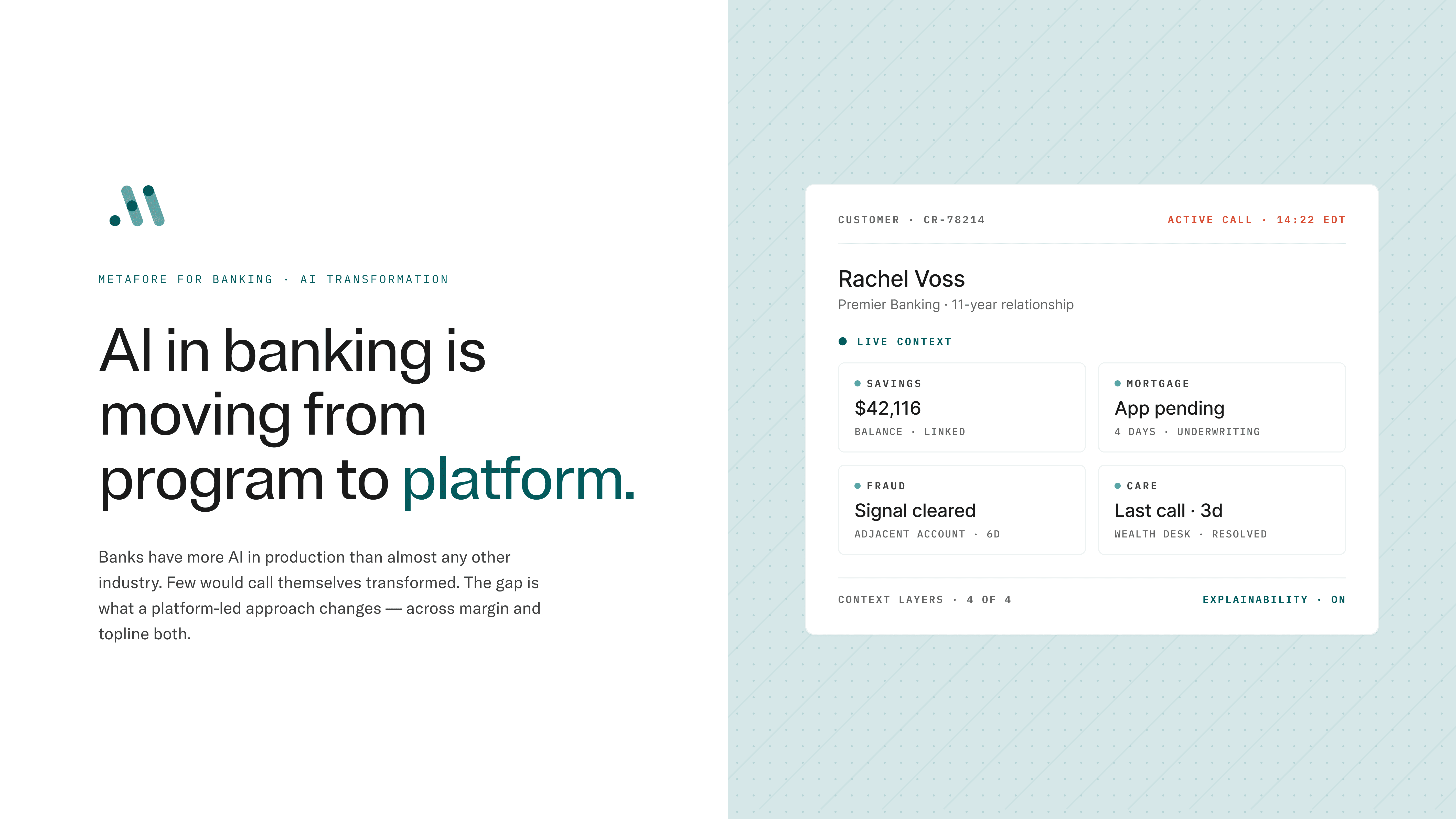
Large banks have been investing in AI for a long time, longer than most industries. Fraud models, credit-decisioning systems, customer-service agents, and back-office automation have been in production for years, often at scale. And yet very few of the banks we speak with would call themselves transformed. What they describe instead is a sprawl of capable AI running in many places, with results that are good in the aggregate and rarely coordinated.
This is the gap AI transformation closes for banking. The ambition is a bank whose operations run on a coordinated, continuously reasoning substrate, from the branch and the call center through to the trading floor and the risk function. Getting there is a platform exercise, and the banks that understand that are already pulling away from the ones still running the work as a portfolio of parallel initiatives.
The shape of transformed banking operations
In a transformed bank, the operating plan is generated continuously from live data — customer behavior, market conditions, portfolio movements, regulatory posture — and translated into coordinated execution across the functions that need to act.
A customer calling about a delinquent card account is handled by an agent reasoning across the full context the bank already holds: the savings balance, the pending mortgage application, the fraud signal that fired on an adjacent account last week, and the call the same customer made to a different department three days earlier. Because the reasoning is shared, the next action is the right action, and the experience the customer has is coherent across every touchpoint the bank exposes.
A credit decision begins with the bank's broader intelligence — the commercial relationship, the deposit history, the sector-level signals flowing through the portfolio, and the sensitivity analysis pulled from recent market movements — and produces an outcome the bank can explain to the customer and to the regulator in the same language. Explainability stops being a separate workstream and becomes a property of how the decision was made.
This is how banking operations look on a shared platform, where every customer interaction and credit decision draws on the bank's full intelligence.
The margin axis
The margin story in banking is the one most executives already believe in, because it is where most of the early AI spend has gone. A transformed bank extends the margin case beyond where point AI has taken it.
Cycle-time compression across the operations stack — customer onboarding, loan origination, KYC refresh, exception handling, complaint resolution — accelerates once the agents handling each process operate against shared context. Transformed banks regularly see high-volume workflows compress from days to minutes, because most of the waiting time between handoffs was always an artifact of disconnected systems.
The other structural margin effect comes from governing autonomy at the platform level. As autonomous decisions scale into the thousands daily, per-agent governance becomes unworkable. A platform that makes governance a system property lets the bank expand its autonomous footprint without a corresponding expansion in compliance overhead. The savings are structural, and they recur every quarter the platform operates.
The topline axis
The topline story is the one most banks underinvest in, and it is where we see the largest differentiation between transforming banks and the rest of the industry.
A bank that reasons across its relationships can propose and deliver products that a fragmented bank structurally cannot. A relationship manager who can see the whole customer, supported by agents that surface the right cross-sell at the right moment, generates measurably more revenue per relationship than one working from dashboards. A wealth client served by a bank that can integrate market views, portfolio positioning, tax context, and life-stage signals into a single recommendation will stay longer and expand the wallet more willingly than one served by a bank that can only do one of those things well at a time.
These gains come from the bank's capacity to assemble intelligence from across its data in service of the customer in front of it, which is exactly what a platform-led transformation delivers.
The orchestration engine
The architecture underneath this is what we call the Enterprise Operating Platform. Operating Plan generates the bank's ongoing view of what should happen, and Operating Execution turns that view into coordinated tasks across agents, data pipelines, and the human teams who do the work. Operating Insight watches the environment for changes in market structure or customer behavior and feeds those signals back into the plan in near real time.
Underneath the platform sits Enterprise General Intelligence, the layer that lets agents reason across the bank's data without that data having to be flattened or centralized into a single lake. EGI is what turns a collection of specialized models into a bank-wide intelligence every agent can draw on.
The orchestration layer is therefore the engine of banking transformation. It is how intelligence moves across departments, products, geographies, and lines of business, so that a capability built for one function becomes available to every function that would benefit from it. Orchestration is also what turns a portfolio of useful point systems into a bank-wide capability, and it is the threshold the bank has to cross before transformation becomes real.
Where to start
We do not believe banks need to choose a single starting domain, but some starting points carry more strategic weight than others. Contact center modernization is a natural entry point because of the combination of volume and data richness, and because the gap between current performance and what a platform-led approach makes possible is one of the widest in the bank. Credit operations often come next, because the regulatory scrutiny forces the explainability and governance work to be done properly from the start. Wealth and commercial relationships are where the topline case becomes undeniable, and for many banks it is the vertical where transformation first pays for itself on the revenue side.
What matters more than the starting domain is the commitment to build each initial deployment on a foundation that will carry every subsequent one. A program that builds a great contact center and then starts from scratch for credit operations will end the decade with several excellent point deployments and very little underlying transformation, which is the opposite of the outcome the work was meant to produce.
The larger shift underneath
There is a larger shift happening at the executive level of banking that is worth naming here. For decades, banks have relied on outside advisory firms to shape their operational strategy, from cost-to-serve redesigns to target operating models to post-merger integration. That model was built for a world where the intelligence a bank needed had to come from outside it.
A platform that reasons continuously across the bank's data, coordinated with agents that execute across the operations stack, changes what has to come from outside and what can now be produced from within. The banks we see moving fastest are the ones treating AI transformation as a way to bring their strategy function home — continuous, operational, and owned — rather than commissioning it one engagement at a time.
We believe the banks that lead over the next decade are the ones treating AI as the substrate of their operations, where every function draws on the same intelligence. The rest will continue to run AI programs, and the gap will widen quarter by quarter.
If AI transformation is on your agenda this year, we would like to be in that conversation.

Article by
Metafore Editorial
Subscribe to Metafore blog
Get notified about new product features, customer updates, and more.
related posts


