Jan 20, 2026
Industry
Enterprise AI Implementation: Root Causes of Project Failure and Mitigation Strategies
The $3 Million Question
A regional bank greenlights a $3 million AI lending system. The team is talented. The business case is airtight. Eighteen months later, the project is still in development—and the board wants answers.
This story plays out constantly. Research from McKinsey, Deloitte, and Gartner puts the failure rate for enterprise AI projects at 70-75%. Banking fares even worse, pushing 75%. Projects that executives expected to deliver in 6-12 months drag on for 18-24. Budgets balloon by 40-60%.
Here's what surprised us when we dug into the data: the technology isn't the problem. The algorithms work. The data exists. What derails these projects is how organizations approach them—architecturally, organizationally, and procedurally.
We're going to break down the five patterns that consistently sink enterprise AI initiatives and outline what's working for organizations that deploy in 8-12 weeks while others remain stuck in development limbo.
The Scale of the Problem
What the Data Shows
The numbers tell a consistent story:
70-75% of enterprise AI projects fail to deliver expected results
Banking experiences the highest failure rates at roughly 75%
Time-to-value averages 18-24 months against executive expectations of 6-12
Cost overruns of 40-60% are standard
Only about 15% of AI projects scale beyond initial pilots
Why is banking hit so hard? Three factors pile on top of each other. Regulatory complexity demands that every decision be auditable and explainable—black-box systems don't survive scrutiny. Legacy system sprawl means most banks operate 3-5 disconnected platforms for lending, CRM, risk, and compliance, turning integration into a mess. And the stakes are higher—an error in AI-driven lending isn't a minor bug but a potential regulatory violation or reputational crisis.
How Failure Actually Unfolds
Enterprise AI rarely crashes spectacularly. It erodes gradually.
The pilot that can't escape the lab. The system performs beautifully on 10,000 historical loan applications. Scaling to 100,000 live customers reveals messier data, unexpected edge cases, and integration headaches nobody anticipated.
The impressive demo that can't ship. Data scientists build something remarkable in a notebook environment—95% accuracy on curated data. Turning it into production software requires two years of engineering. The business case dies waiting.
The accuracy cliff. Testing on clean historical data yields 92% accuracy. Production data is messier, customer behavior differs from historical patterns, and accuracy drops to 67%. Nobody can explain why.
The compliance crisis. Six months into development, someone from compliance asks: "Can you explain why the AI rejected this customer?" The honest answer—"the model decided"—doesn't satisfy regulators. Development halts for a six-month rebuild.
The system nobody trusts. The AI launches, but the operations team doesn't believe in it. Adoption stalls at 20% when the business case assumed 80%. The ROI never materializes.
The Cost of Inaction
Standing still while competitors move forward compounds the damage.
Market position erodes. Fintech competitors deploy AI systems three times faster, reaching customers first and building advantages that become harder to overcome.
Resources vanish without results. A failed $3M project doesn't just disappear. It becomes a drag on future initiatives, eroding confidence in technology investments.
Talent walks away. Engineers who spent 18 months on a project that never shipped don't stick around. The best ones leave. The ones who stay are burned out.
Liability accumulates. Poorly designed AI creates legal exposure. A discriminatory lending algorithm isn't just bad business—it's a regulatory problem.
Five Patterns That Sink AI Projects
Pattern 1: The Monolithic Trap
The thinking: Our business is unique, so we need a unique AI system. Build one massive, custom platform that handles underwriting, compliance, pricing, and customer segmentation in one integrated whole.
What actually happens: This takes 12-24 months minimum. The moment requirements shift—and they always do—the system becomes brittle. Regulatory changes mid-project? Rearchitect. New business priorities? Rebuild.
What it costs: $2-5M in direct implementation, plus 18+ months of opportunity cost.
One mid-size bank built a lending AI tailored to their exact workflows. Eight months in, regulators issued new explainability guidance. The black-box approach they'd chosen no longer met requirements. Six months of retrofitting followed. Final timeline: 24 months. Final cost: $4.2M.
About 40% of monolithic AI projects get abandoned or heavily restructured mid-implementation because requirements or regulatory environments changed.
Pattern 2: The Integration Quagmire
Banks don't run on one system. They run on five: core banking, CRM, compliance, risk management, fraud detection. These systems barely communicate. Data flows inconsistently. Logic conflicts between them.
The conventional response is to integrate everything with APIs and data pipelines. Set up ETL processes. Unify the data. Then build AI on top of that unified foundation.
Why does this fail? Integration becomes a black hole. Data conflicts surface everywhere. One system shows a credit score of 750; another shows 720. One has a current address; another has an outdated one. The AI ends up working on only 60% of relevant data because the rest is trapped in systems that won't integrate cleanly.
The outcome: incomplete decisions. The AI recommends approval, but execution stalls because data from a critical system is missing. Operations overrides the AI manually. Adoption collapses.
Pattern 3: The Black Box Problem
Organizations deploy machine learning or large language models that make good decisions but can't explain them. The model has thousands of parameters. Nobody can articulate why it approved one loan and denied another.
Banking regulators—OCC in the US, FCA in the UK, and the EU AI Act globally—now mandate explainability. If AI makes lending decisions, regulators want audit trails. They want to see logic. They want assurance the system isn't discriminating.
Here's how it plays out: An AI system ships and performs well for 3-4 months. Then the regulator audits. They ask about a specific denial: "Why did the system reject this customer?" The answer—"the neural network decided"—isn't acceptable. The system shuts down. Six to twelve months of rebuilding follows.
Three major European banks have had to rebuild lending AI systems in the past 18 months due to explainability gaps. Average retrofit cost: €8-12M.
Pattern 4: The IT Project Fallacy
There's a business problem. Hand it to IT. IT adds AI to existing workflows, builds the system, deploys it, hands it off.
But AI adoption isn't an IT challenge—it's an operational change. Loan officers who've made decisions a certain way for 20 years need more than new software. They need trust, training, and reasons to change behavior.
Who gets left behind: The operations team never learned the system. Sales doesn't trust the AI's recommendations. Executives don't understand how ROI was calculated. The system ships, but adoption never follows.
The result: 20% adoption instead of the 80% the business case required. The system becomes expensive shelfware. Management loses confidence in AI, making future initiatives harder to fund.
Pattern 5: The Integration Surprise
Executives assume: "We have a data warehouse. We have customer data. Adding AI should be straightforward."
Reality: Data quality issues, API brittleness, and real-time versus batch processing conflicts stay invisible until production.
Example: A customer service AI needs to respond within 2 seconds. But the data pipeline takes 5 minutes to pull current customer information. The AI can't access data fast enough, makes decisions on stale information, and quality suffers.
Everything works perfectly in controlled sandbox environments. Production introduces chaos. Weeks disappear debugging integration issues instead of improving the AI.
A Different Architecture
The organizations moving fastest aren't building better monoliths. They're building something structurally different.
The Shift
Old approach: Build one massive AI system that handles the entire process. New approach: Deploy focused, modular agents that handle specific decisions, then orchestrate them together.
Old approach: Optimize for black-box accuracy (highest precision on test data). New approach: Optimize for explainable, auditable logic that regulators approve.
Old approach: 18-month implementation, then "done." New approach: 8-12 week deployment, then continuous monthly improvement.
Side-by-Side Comparison
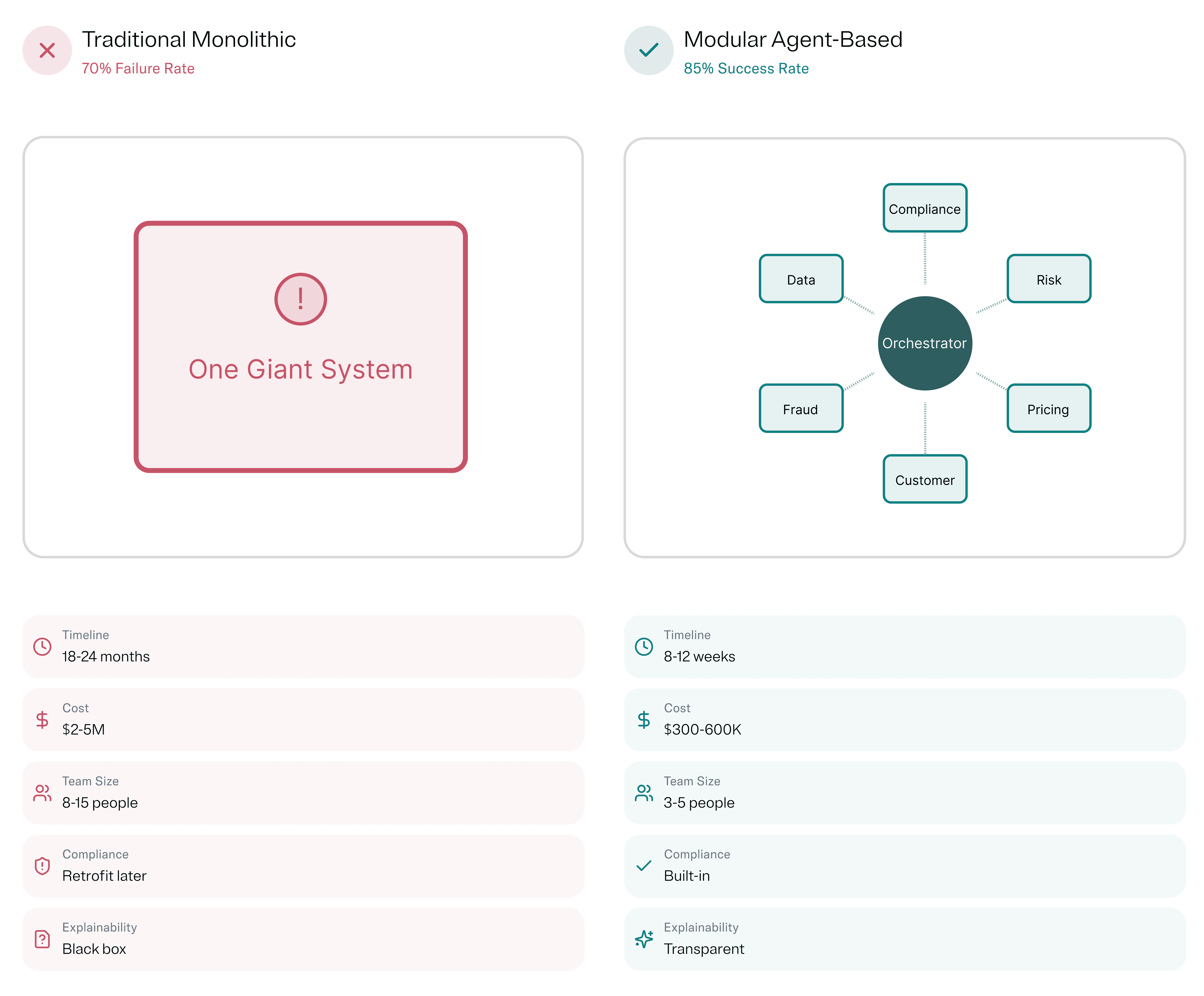
Traditional lending AI: Build one system handling underwriting, compliance, pricing, and customer segmentation in an integrated whole. Eighteen months. $3M. Changing one piece risks breaking everything else.
Modular approach:
Agent 1: Compliance checking (Does this customer meet regulatory requirements?)
Agent 2: Risk assessment (What's the credit risk profile?)
Agent 3: Pricing logic (What interest rate fits the risk?)
Agent 4: Customer profiling (What do we know about this customer?)
Each agent is focused and testable in isolation. Changing compliance rules means updating Agent 1. Adjusting risk models means updating Agent 2. Everything else stays stable.
How This Fixes Each Failure Pattern
Monolithic trap? Modular agents scale incrementally. Add or remove agents without rebuilding the whole system.
Integration quagmire? An orchestration layer sits above fragmented systems, unifying logic without the integration nightmare. Legacy systems stay unchanged—they're called when needed.
Black box problem? Agents operate with transparent decision logic. Every decision is auditable. Regulators see exactly how conclusions are reached.
IT project fallacy? Faster deployment means operations can adapt faster. Training happens over weeks rather than quarters. Trust builds through experience.
Integration surprise? Pre-built connectors to legacy systems. Batch versus real-time processing handled automatically. No surprise brittleness in production.
Why Organizations Are Moving to This Now
Regulatory pressure keeps building. Explainability is mandatory. Black-box systems face forced rebuilds. Systems designed for explainability from day one avoid that pain.
Competitive pressure is real. Fintech competitors deploy new capabilities every 4-6 weeks. Organizations using 18-month cycles can't keep pace.
The economics work. Modular approaches cost 30-40% less to implement than traditional monolithic systems. And you don't need armies of ML engineers—product managers, business analysts, and a smaller engineering team can handle it.
A Practical Path Forward
This sequence works for organizations starting fresh or rebuilding after a failed attempt. Timelines are adaptable, but the order matters.
Phase 1: Deploy One High-Value Agent (Weeks 1-4)
Pick the single highest-impact use case rather than attempting everything at once. In banking, this might be loan underwriting (highest volume, clearest ROI), customer onboarding (fastest path to production), or compliance checking (regulatory pressure, immediate value).
Deploy one focused agent. Measure it:
Time saved per decision
Error rate reduction
Compliance metrics improvement
Customer satisfaction impact
This proves ROI and builds internal momentum. When stakeholders see a working AI system delivering value in 8 weeks, the next agent becomes easier to champion.
Phase 2: Build Compliance In From the Start (Weeks 1-12)
Don't treat compliance as a final checkbox. Make it a design principle from day one.
Every decision the agent makes has a clear audit trail. The compliance team reviews the agent's logic—not ML weights, but actual decision rules. Before deployment, compliance formally approves the decision framework.
This avoids the trap where you ship an AI system only to have regulators demand explainability six months later.
Phase 3: Orchestrate Rather Than Integrate (Weeks 1-12)
This architectural choice changes everything.
Don't: Try to integrate all legacy systems into one unified data layer.
Do: Build an orchestration layer that sits above existing systems. The orchestration layer calls legacy systems as needed. Legacy systems remain unchanged.
You avoid the 18-month integration project. You don't rebuild core banking or CRM. You add a layer that knows how to communicate with them.
Phase 4: Assemble a Cross-Functional Team (Weeks 1-12)
Handing the project to IT and stepping away is where most projects fail quietly.
Who needs to be involved:
Operations: They understand the actual process and know where real complexity hides.
Compliance/Risk: They catch problems early and make sure regulatory requirements are met.
IT: They manage infrastructure and handle integration with the technology stack.
Business Sponsor: They keep the project aligned with business goals and clear political obstacles.
Weekly syncs for the first 8 weeks. Monthly afterward as the system matures.
Phase 5: Plan for Continuous Improvement (Ongoing)
The moment an agent deploys, it starts generating data about its decisions. That data is gold.
Month 1: The agent processes 500-1000 decisions. Operations reviews performance.
Month 2: Analytics identifies patterns. Example: "Customers with 5+ years employment have 2% lower default rates." Proposed improvement: "Approve with lower credit scores when employment exceeds 5 years." Compliance reviews. Improvement deploys.
Month 3+: The pattern repeats. The system improves every month.
After six months, performance is typically 20-25% better than at launch.
Budget Reality
Traditional Approach
Component | Cost |
|---|---|
Implementation | $2-5M |
Timeline | 18-24 months |
Team size | 8-15 people |
Ongoing maintenance | 2-3 FTEs |
Modular Approach
Component | Cost |
|---|---|
First agent | $300K-600K |
Timeline | 8-12 weeks |
Team size | 3-5 people |
Ongoing maintenance | 1-2 FTEs |
Additional agents | $100-200K each |
ROI Comparison
Traditional: 24-36 months to break even. Spend $3M. Wait two years before the investment is justified.
Modular: 6-9 months to break even. First agent costs $300-600K and starts delivering value in 8 weeks.
Faster deployment means faster value realization. You're not waiting 18 months to start measuring impact.
Scaling Economics
After the first agent, each one gets faster and cheaper:
Agent 1: $300-500K (infrastructure, processes, governance established)
Agent 2: $150-250K (processes exist; infrastructure is ready)
Agent 3: $100-150K (team has done this twice; it's routine now)
Agent 4+: $75-100K each
After four agents, total spend is roughly $700K-1M. Traditional approach for the same capability: $2-5M.
Frequently Asked Questions
Are those 70-75% failure rates real?
Yes. McKinsey, Deloitte, and Gartner all report similar figures. McKinsey's most recent research found that 71% of AI projects haven't scaled beyond pilots. Banking's rate is higher due to regulatory complexity and legacy system challenges. These numbers capture not just complete failures but projects that miss expected ROI or take far longer than planned.
We already have a failed AI project. Can it be salvaged?
Depends on the failure mode. If the problem was architectural—monolithic design, black-box AI, no compliance involvement—rebuilding with a modular approach is usually faster than fixing the original system. We've seen banks redirect failed projects and go live in 12-16 weeks instead of spending another 12 months debugging.
If the failure was organizational—no operations buy-in, unclear business case—technology wasn't the real problem. Fix the process before rebuilding.
How can we tell if we're building monolithic or modular?
Ask: "If compliance rules change, can we update just the compliance agent without touching anything else?" If changing one part requires rebuilding multiple parts, you're building monolithic.
What if our legacy systems can't connect to an orchestration layer?
Most legacy systems built in the last 10-15 years have APIs. For those that don't, options exist: middleware that translates API calls into the legacy system's native protocol, lightweight adapters, or a phased approach that modernizes the most critical legacy system first.
"Our legacy systems won't integrate" is rarely a true blocker. Workarounds almost always exist.
Doesn't modular mean sacrificing optimization?
No. A monolithic system can optimize everything together but becomes fragile. A modular system optimizes each agent independently and stays resilient. If one agent underperforms, you fix it. Others keep working.
Over time, modular systems often outperform monolithic ones because you can improve continuously without risk of breaking unrelated functionality.
How much does vendor choice matter?
Less than you'd think. The success factors are: explainability by design, clear governance with human approval of changes, cross-functional teams, and continuous improvement processes. Different platforms can deliver these. The approach matters more than the vendor.
Where This Is Headed
Every financial institution will deploy AI. The question is whether it takes 12 weeks or 18 months.
The 70-75% failure rate isn't inevitable. It results from outdated approaches: monolithic systems, black-box optimization, 18-month timelines, IT-led projects without operational buy-in.
Organizations that adopt modular, orchestrated, explainable agents ship faster, spend less, and maintain better regulatory standing.
A few things are driving urgency right now:
Regulatory requirements keep tightening. Explainability is non-negotiable. Organizations with compliant AI will win. Those rebuilding for compliance will fall behind.
Competitive pressure is real. Fintech competitors ship new capabilities every 4-6 weeks. You can't compete with 18-month cycles.
Customer expectations keep rising. Personalized, AI-driven experiences are becoming table stakes.
In 2-3 years, this approach will be standard. The organizations moving now will hold meaningful advantages on operational metrics.
Moving Forward
If you're evaluating your AI approach or planning a new initiative:
Subscribe to our newsletter for ongoing insights on enterprise AI implementation and what's working in banking.
Get in touch if you're actively planning an initiative and want to discuss your specific use case, timeline, and budget. Contact us to talk through your approach.
The question isn't whether to adopt AI—it's whether you'll be live in 12 weeks or still in development 18 months from now. The technology is ready. Your approach determines the outcome.

Article by
Metafore Editorial
Subscribe to Metafore blog
Get notified about new product features, customer updates, and more.
related posts


